The Right Repair for the Confirmed Leak Source. No Blanket Sealant First.
Chimney leak repair corrects the specific component letting water into your chimney system. That means flashing replacement when the metal seal has failed, crown reconstruction when the cap has cracked through, mortar joint repointing when the joints are eroding, or liner work when water is reaching the interior through the flue itself. The repair is determined by the diagnosis, not by a default treatment applied before the source is confirmed. Our chimney leak inspection and diagnostics process ensures we identify the exact source before any work begins, following Chimney Safety Institute of America standards for diagnosis-first repair methodology.
At 832 Home Service, we match every repair to its confirmed leak source. A chimney leaking after rain in Houston TX could be letting water in through any one of five separate entry points, or several at once. We identify which one before any work begins.
Years repairing Houston chimney leaks since 2010
Separate water entry points we diagnose before any work
Serving Greater Houston
Metro communities served across Greater Houston
Gulf Coast storm cycles don’t leave much time between events to ignore an active chimney leak.
Here’s what most homeowners don’t realize about chimney water damage in Houston. After the first rain event, water sits in the pores of the brick and mortar. The second storm pushes it deeper. By the third storm, the pattern of frequent, high-volume rainfall events including tropical depressions and severe thunderstorm lines, as tracked by the National Weather Service Houston storm data, surface dampness becomes firebox damage. You can learn more about how Gulf Coast storm cycles and chimney water damage compound each other across seasons.
If you’ve just experienced a Gulf Coast rainfall event and are seeing active water intrusion, emergency chimney leak repair after storm damage is available to address urgent conditions before the next storm cycle arrives.
832 Home Service has repaired chimney leaks across the Houston metro since 2010. That includes communities along the Brazoria County line, Pearland, Friendswood, Alvin, and Manvel, where post-tropical-storm saturation routinely produces multi-source leak conditions requiring full chimney repair for multi-source conditions. In that southern suburban corridor, clay-soil movement under the foundation adds mechanical stress that compounds what the water already started. Single-point fixes rarely cover the full picture there.
The takeaway is straightforward. A chimney leak repair Houston homeowners delay through one more season becomes a chimney water damage repair Houston homeowners pay significantly more for, see what Houston homeowners pay for delayed chimney repairs to understand the full cost difference. Investing in preventive chimney waterproofing and sealing after confirmed repairs are complete is one of the most effective ways to slow water damage progression between storm seasons.
Before any repair equipment comes out, we identify the chimney leak source with precision. That means a component-by-component water test, a visual inspection of the crown, flashing, mortar joints, cap, and any exposed liner. We note where water appears and under what conditions. Multi-source conditions, more than one active leak path, get a repair sequencing plan before we quote a single line item. This phase also confirms whether a water-damaged firebox exists. If the interior shows rust on the damper, spalling refractory brick, or deterioration on the smoke shelf, that gets documented. Interior damage changes the repair scope and the urgency level.
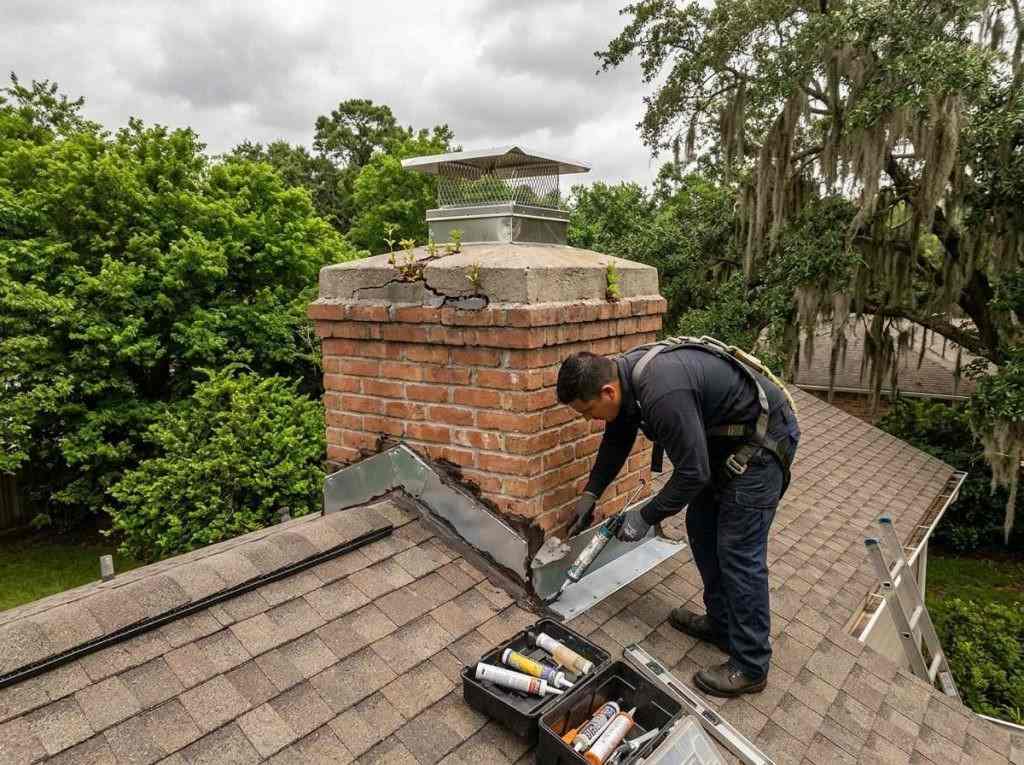
Repairs proceed in sequence. Structural work first: crown reconstruction or full crown repair, mortar joint repointing where joints have eroded beyond surface erosion, chimney flashing repair or full replacement where the metal seal has failed. Cap replacement if the existing cap is contributing to water entry. Each repair is completed and allowed to cure before the next phase begins. We don't rush the cure window to fit a tighter schedule. On chimney water damage repair Houston projects with multiple sources, this sequencing is what separates a repair that holds from one that requires a return visit.
After all structural repairs are cured, we run a water test from the top of the chimney. This confirms that every identified entry point has been addressed before waterproofing is applied. If the test reveals a remaining point of entry, we identify and repair it before the sealant phase begins. The written project record includes repair scope, materials used, application rates, cure windows observed, and water test results.
A Pasadena call from a few years back illustrates why sequencing determines whether a repair holds.
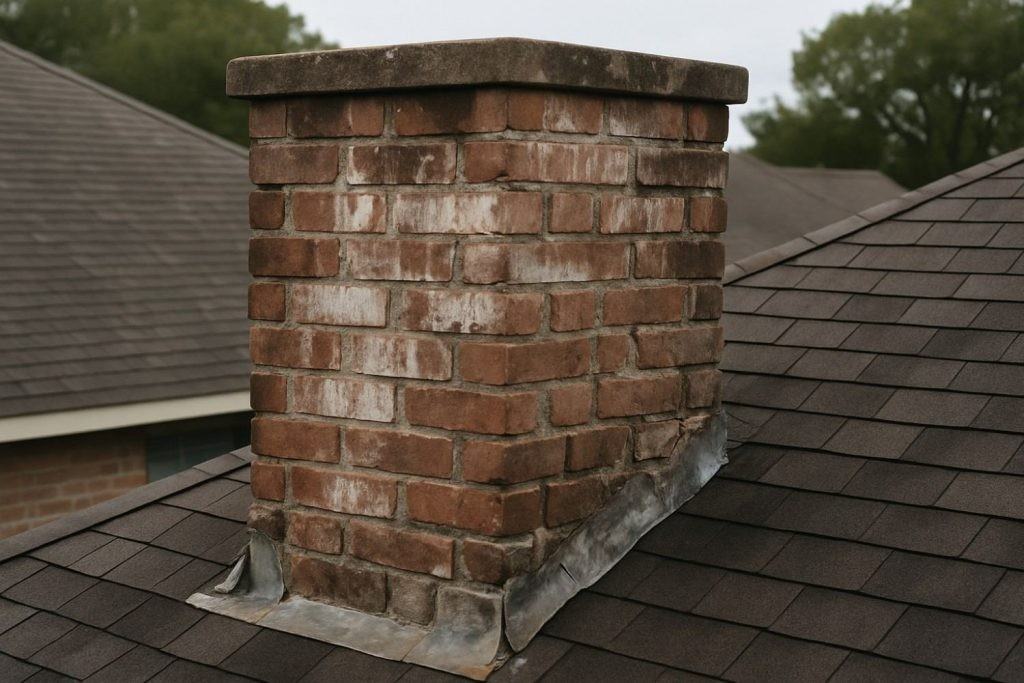
The homeowner had two contractors out in the previous eighteen months. Both identified the flashing as the problem. Both applied sealant at the base. Both times, the chimney was still leaking by January. When we pulled back the top-sealed area and ran a water test section by section, here’s what we found: yes, the flashing had partially lifted at the back corner. But the larger volume of water was coming through the crown. It had a hairline crack running front to back, not visible from the roofline without getting close, and that crack had been directing water straight into the junction between the crown and the chimney face.
The chimney leak source in this case wasn’t primarily the flashing. The flashing was a secondary contributor. Applying sealant to the flashing twice had addressed maybe 20 percent of the water entry. The crown crack was doing the rest.
We began with chimney crown repair and reconstruction after cracking through was identified as the primary water source. Repair sequencing, the order in which multiple leak sources are addressed, matters here because structural repairs need to hold before sealing is applied over them. Crown before flashing. Flashing set in mortar and mechanically fastened. No sealant applied until both were cured and a water test confirmed the result. The homeowner called after the first full rain season to say the fireplace wall was dry for the first time in two years. That’s source-matched repair. It takes longer to diagnose correctly. It doesn’t cost the homeowner more, it costs them less, because you’re not paying for a second repair when the first one doesn’t hold.
Waterproofing applied before repairs are complete traps moisture inside the masonry.
We hear this question regularly: “Can we just seal everything now and come back for the repair later?” The answer is no, and here’s why it matters. Applying a sealer over an active water intrusion path traps moisture inside the masonry. That trapped moisture still cycles through the brick during Houston’s wet-dry seasons. It has nowhere to escape. The result is accelerated spalling and mortar deterioration from the inside out.
A water-damaged firebox, where repeated water intrusion has caused spalling of the refractory brick and rust on the damper, is almost always the downstream result of deferred repairs with surface sealant applied over them.
We do apply chimney waterproofing. We use vapor-permeable sealers that allow the masonry to breathe. But that step comes after every structural repair is confirmed, cured, and tested. The sequence is non-negotiable because the physics require it.
Every chimney leak repair we complete follows documented material and method standards matched to the confirmed source. Three coats of sealant over a cracked crown is not a repair. It’s a delay.
Two-part mechanical system, step flashing plus embedded counter flashing set in mortar. Sealant-only flashing repairs crack under Houston's thermal cycling.
Mortar joint repointing for eroding joints uses a mix matched to the chimney's age and original mortar composition before work begins. Portland cement in a historic lime-mortar chimney damages the surrounding brick.
Vapor-permeable repellent only. Product type and application rate documented per chimney. Applied after all structural repairs are cured and water-tested.
Demolition of the failed crown, custom-formed replacement with minimum 2.5-inch overhang on all sides, drip edge incorporated. No stock-form replacements.
Camera assessment confirms liner condition before any relining decision is made. We size to the appliance connected to your system.
Yes. Every chimney leak repair we complete begins with a confirmed source. We run a component-by-component water test across the crown, flashing, mortar joints, cap, and exposed liner before quoting any line item, so the repair matches the actual entry point rather than a default treatment.
Applying a sealer over an active water intrusion path traps moisture inside the masonry. That trapped moisture still cycles through the brick during Houston’s wet-dry seasons with nowhere to escape, which accelerates spalling and mortar deterioration from the inside out. Waterproofing is always the final step after structural repairs are cured and tested.
Absolutely. A chimney leaking after rain could be letting water in through any one of five separate entry points, or several at once. Multi-source conditions get a repair sequencing plan, structural repairs first, so each fix holds before the next phase begins.
It costs less over time. Diagnosing correctly takes longer up front, but you’re not paying for a second repair when the first one doesn’t hold. Delaying a leak through one more storm season is what turns a chimney leak repair into a far more expensive chimney water damage repair.
Yes. If you’ve just experienced a Gulf Coast rainfall event and are seeing active water intrusion, emergency chimney leak repair after storm damage is available to address urgent conditions before the next storm cycle arrives.
(832) 662-3437
832 Home Service dispatches crews for chimney leak repair across the full Greater Houston metro.
The repair scope grows with every storm cycle that passes without a confirmed fix in place. Call 832 Home Service to schedule your chimney leak repair in Houston. Describe what you’re seeing,…
Call 832 Home Service at (832) 662-3437 or email info@832chimneyservices.com to schedule your Chimney Leak Repair assessment.
WhatsApp us
Tell us what’s going on and we’ll get back to you, often the same day.
Prefer to talk? (832) 662-3437