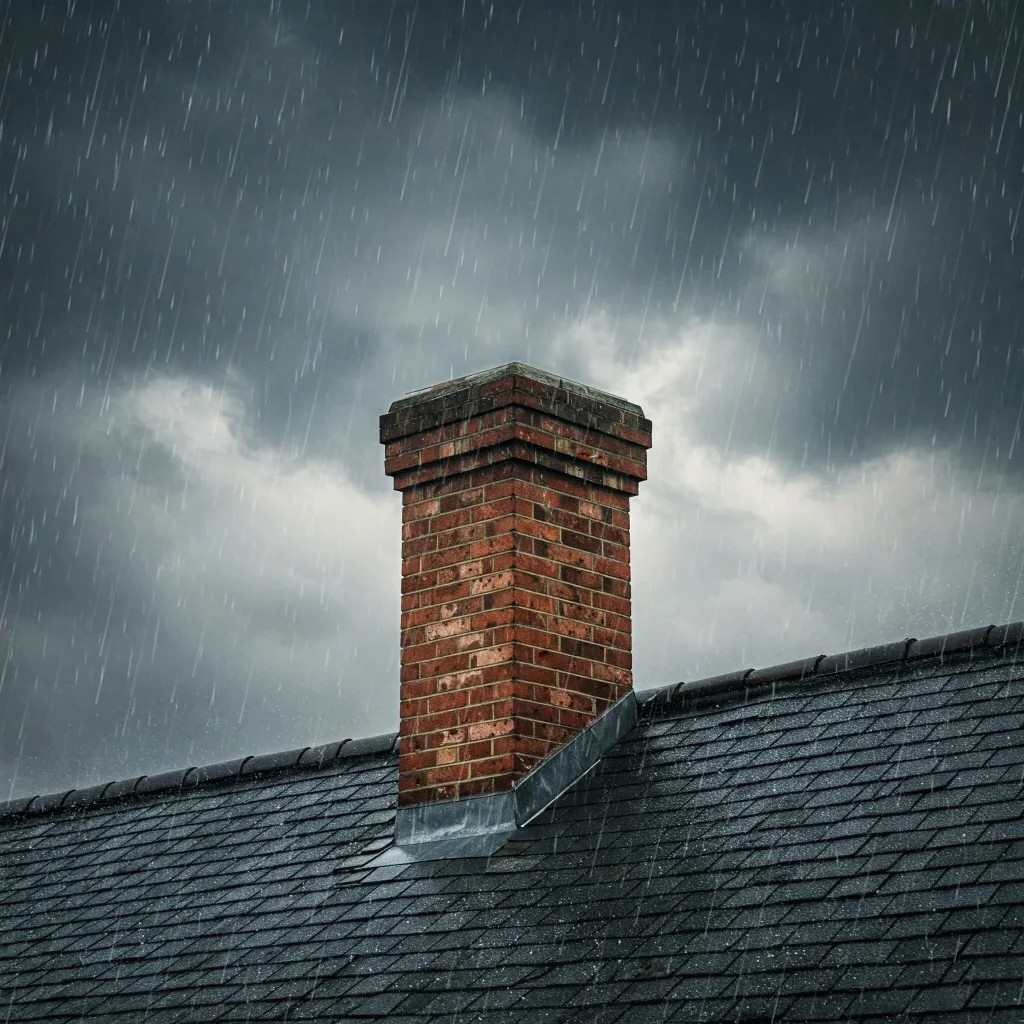
A storm that displaces the cap also loads the crown, stresses flashing, and shifts mortar joints. We assess every component, cap to roofline, and document all of it for your insurance carrier.
A storm that displaces the cap also loads the crown, stresses flashing, and shifts mortar joints, all in the same event.
The cap is gone. Or there’s a crack across the crown you can see from the yard. That’s the storm damage visible from the ground.
What most Houston homeowners don’t realize after a major storm: the component you can see is rarely the only one affected.
Hurricane wind loading, the sustained force applied to exposed chimney masonry by tropical storm and hurricane winds, reaches 90 to 130 mph in a Gulf Coast event. That force acts on every component above the roofline at once, not just the cap.
Post-storm multi-component failure means two or more chimney parts sustain damage in a single storm event. Cap displacement. Crown cracking. Flashing separation, the lifting of chimney flashing away from the roofline or mortar bed during high-wind events, opens a water entry gap at the chimney-to-roof junction. That gap is invisible from the driveway. A brick shift at the roofline may be equally hidden.
The visible damage is the starting point. The full assessment finds the rest.
832 Home Service conducts a complete storm assessment scope, cap, crown, flashing, mortar joints, visible liner opening, and exterior masonry from roofline upward, on every post-storm call. We inspect what the storm touched, not only what photographs from the yard can show.
Written findings and photographs from every affected component, formatted for direct submission to your homeowner insurance carrier.
Most homeowner insurance carriers require chimney insurance documentation for storm claims: a written assessment with photographic evidence of each damaged component, the probable cause of each failure, and the recommended repair scope. A single photograph of a missing cap does not satisfy that requirement.
Our post-storm assessment produces a complete written record. Every component inspected is documented. Every finding is photographed. The report format matches what insurers need to evaluate the claim scope.
Here’s why this matters in Houston specifically. After a named tropical system or a major thunderstorm line moves through Harris County, insurers process a high volume of simultaneous claims. A well-documented chimney report moves through that process faster than one requiring a follow-up adjuster visit to confirm components the initial report didn’t address.
The written assessment also defines the repair scope independently of the insurance process. Whether the claim is approved in full, partially, or not at all, the homeowner has a documented record of every component the storm affected. That record becomes the basis for the repair, not a guess.
Every post-storm assessment covers every component above the roofline, cap, crown, flashing, brick joints, and liner opening, before any repair scope is written.
Condition, displacement, or absence documented; anchor points checked if cap is still present.
Full perimeter checked for wind-stress fractures and hail impact cracks, not just the visible front face.
Counter flashing and step flashing checked for wind uplift separation, not assumed intact because the cap survived.
Roofline-to-crown section checked for wind-driven water infiltration and joint displacement.
Exterior masonry above the roofline is checked for loose, shifted, or dislodged bricks caused by wind or impact.
Visual check of the flue opening from the top for debris, impact stress, or displaced crown material.
832 Home Service covers Houston’s Gulf-facing southeastern corridor, including Galveston, Texas City, La Marque, and League City, where Gulf of Mexico storm tracks produce the most frequent and most severe chimney storm damage in the region.
These coastal communities sit directly in the landfall and near-landfall path of Gulf storm systems. Hail impact damage, the surface and structural damage produced by large hailstones striking chimney crowns, caps, and exposed masonry, is a separate mechanism from wind loading, and these communities experience both in the same storm event.
Homeowners preparing for severe weather can also consult FEMA’s official website for disaster preparedness and recovery resources.
A one-inch hailstone striking a concrete chimney crown at storm velocity can crack the crown across its width in a single impact. That same storm may have pushed sustained winds that separated the cap and pulled flashing from the counter flashing bed. Both damage types. Same event.
832 Home Service has assessed chimneys across Galveston and Harris County following named tropical systems since 2010. The storm damage pattern in the Gulf-facing corridor is distinct from inland Houston. Cap displacement rates are higher. Crown cracking from combined wind and hail exposure is more frequent. Flashing separation at the roofline is nearly universal on older chimneys after a direct storm track event.
Post-storm assessment slots fill quickly across the region after a named storm. Call (832) 662-3437 to get on the schedule.
You do not need to wait for the adjuster, our assessment report is what the adjuster uses.
This is the most common scheduling question we receive after a major storm event. The homeowner has filed an insurance claim. They’re waiting for the adjuster’s visit. They assume the assessment has to happen after, or through, the insurance process.
It works the other way.
The adjuster evaluates chimney storm damage based on documentation. Our written report and photographs are the primary documentation they reference. We assess the chimney, document every component, and deliver a written report that goes directly to your claim file.
Getting the assessment done before the adjuster visit means the adjuster arrives with a complete, documented finding. It speeds the claim. It prevents undercounting of affected components.
One call to 832 Home Service starts that process: (832) 662-3437.
The assessment is systematic, documented in sequence, and delivered as a written report before the crew leaves the property.
We start with a ground-level visual survey, then access the roof for a full top-down assessment. We check the cap, crown, flashing, mortar joints, and exterior masonry for storm damage. Hail damage may appear as radial cracks in concrete crowns, while wind damage can show as lifted counter flashing or separated mortar joints. All findings are documented.
If any component presents an immediate structural hazard, a dislodged brick at roofline height, a crown section that is no longer bearing, we address stabilization before leaving the site. Temporary caps are installed on open flues. The repair scope is written based on all documented findings, not just the reported symptom.
The written assessment report is completed on-site and delivered digitally. It includes: component-by-component findings, photographs of each affected component, probable cause notation for each finding, and a recommended repair scope. This is the document that goes to your insurance carrier and guides the repair.
Other work Houston homeowners commonly pair with this service.
Crown to firebox, repaired as one scope.
Water coming in during the storm itself.
Storm-lifted flashing is a common leak path.
A cracked crown after impact needs rebuilding.
Answers to common questions about post-storm chimney assessment in Houston.
No. Our written assessment report and photographs are the primary documentation the adjuster references. Getting your assessment done first means the adjuster arrives with a complete, documented finding, which speeds the claim.
Yes. We produce a complete written record with component-by-component findings, photographs of each affected component, probable cause notation, and a recommended repair scope, formatted for direct submission to your homeowner insurance carrier.
Yes. Storms distribute their load across the full exposed chimney. Flashing separation, crown cracking, and mortar joint displacement can occur even when the cap survives, and much of that damage is invisible from the ground.
Post-storm assessment slots fill quickly across the region after a named storm. Call (832) 662-3437 to get on the schedule as soon as possible.
Yes. Hail impact damage and hurricane wind loading are separate mechanisms that often occur in the same storm event. We document both, hail cracking on crowns and wind uplift on flashing, in our assessment.
(832) 662-3437
832 Home Service covers the full Greater Houston area for emergency storm damage repair, coastal communities to inland suburbs.
Contact our team today for a free consultation. Tell us what happened, storm date, what you can see, your address, and we’ll schedule your post-storm assessment.
Contact our team today for a free consultation. Call 832 Home Service at (832) 662-3437 or email info@832chimneyservices.com
WhatsApp us
Tell us what’s going on and we’ll get back to you, often the same day.
Prefer to talk? (832) 662-3437