Vapor-permeable sealer applied, with product type and rate documented per chimney.
Chimney waterproofing in Houston means applying a penetrating, vapor-permeable water repellent to exterior masonry after every structural repair is finished.
This is the final step in protecting a Houston chimney. Not the first one. Not a standalone fix applied over unrepaired joints or a cracked crown. We always recommend completing a chimney leak inspection before scheduling waterproofing to ensure the sealer is applied to a structurally sound surface. Masonry is porous by nature. Brick and mortar absorb moisture during rain and release it as surfaces dry. In Houston – where annual rainfall runs close to National Weather Service Houston rainfall data shows 50 inches per year and rain arrives frequently rather than seasonally – that absorption-and-release cycle repeats dozens of times per year. To understand how Houston’s rainfall accelerates masonry damage, it helps to consider how each cycle opens pore structures slightly. Over seasons, those pores widen. Water reaches deeper into the masonry with each subsequent rain event. A chimney waterproofing service – the application of a penetrating water repellent to exterior chimney masonry stops that progression. But only if the product is chosen correctly and applied in the right sequence. Our application standards follow Chimney Safety Institute of America standards for product selection and sequencing, ensuring every treatment is performed in the correct order after all structural repairs are complete. If a cracked crown repair services in Houston is needed, that work must be finished and cured before any sealer is applied. 832 Home Service applies only vapor-permeable water repellents. We document the product type and application rate – the volume of repellent applied per square foot of masonry surface – for every chimney we treat. That record stays on file.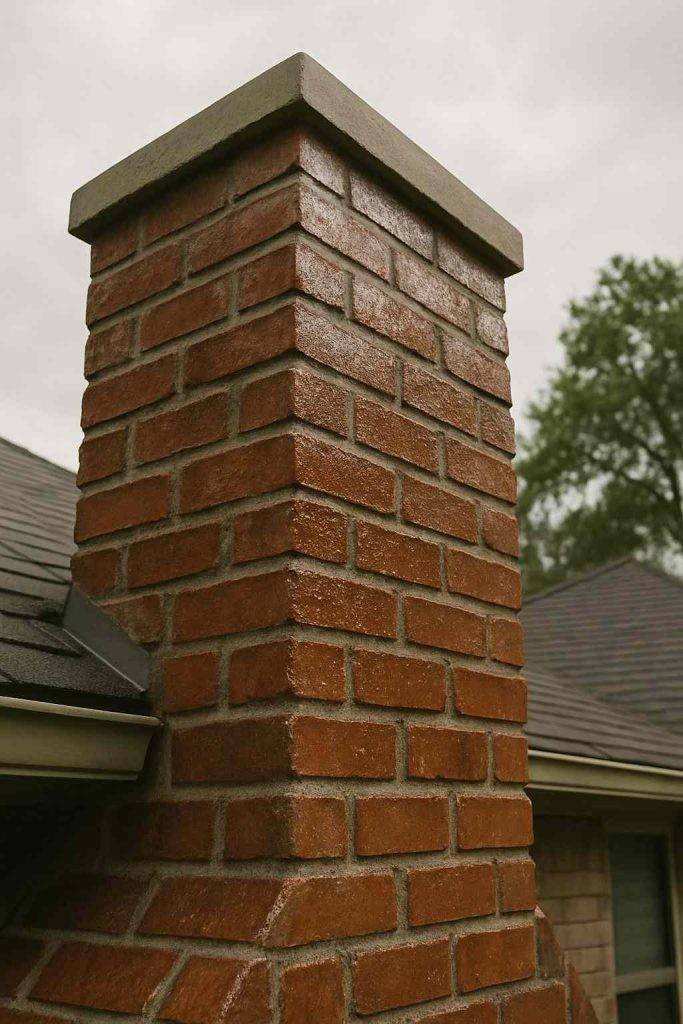
832 Home Service has applied chimney waterproofing treatments across the Houston metro since 2010, including in coastal communities where product selection is critical.
Pearland, Friendswood, and League City sit in Houston’s direct Gulf moisture corridor. Chimneys in these communities absorb rainfall at rates that exceed properties further inland. After a named tropical weather event, masonry saturation levels in these areas can remain elevated for days. Applying a sealer over saturated masonry traps that residual moisture inside the brick body – which is exactly what the wrong product does.
Here’s what most homeowners don’t realize about chimney waterproofing: the product category matters more than the brand. A film-forming sealer – a surface coating that creates a continuous barrier layer over masonry – blocks both water entry and vapor transmission. That sounds effective. In a climate like Houston’s, where masonry is frequently saturated, it creates a moisture trap inside the structure.
A vapor-permeable water repellent – a penetrating sealer that blocks liquid water from entering while allowing water vapor to escape – solves the entry problem without creating a new one. That is the only product category 832 Home Service applies.
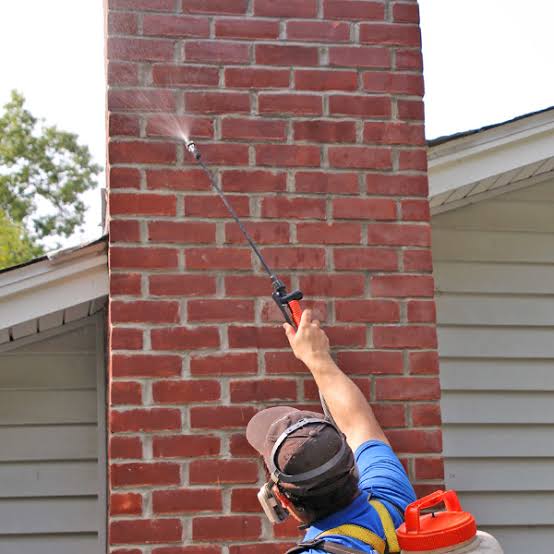
Our crews in Pearland and League City have treated chimneys within 72 hours of storm events. In those cases, we reschedule if moisture readings confirm the masonry has not dried sufficiently. Wet masonry gets rescheduled, not sealed over.
Every chimney waterproofing job at 832 Home Service follows the same documented standards product category, application rate, and sequencing rule. We apply the same standards to a single-flue brick chimney in Friendswood as we do to a multi-flue stack in The Woodlands. The documentation follows the same format either way. Our process is not flexible on the following points:
Vapor-permeable penetrating repellent only. No film-forming sealers on exterior chimney masonry.
Waterproofing is applied only after structural repairs - crown, mortar joints, flashing, spalling brick - are complete and cured. This includes mortar repointing before waterproofing is applied to ensure every joint is fully closed and cured before the water repellent goes on, as well as completing any spalling brick repair Houston homeowners need first before sealer is applied. No exceptions.
Product type, application rate, date, and technician on every job. Filed and accessible.
Surface moisture is confirmed acceptable before product goes on. Chimneys with elevated readings are rescheduled.
The full above-roofline section - the primary weather exposure zone - receives treatment. Not just visible front faces.
The volume of water repellent applied per square foot is recorded for every chimney. This determines how deeply the product penetrates and how long treatment remains effective.
The waterproofing application process has three phases: surface assessment, product application, and post-service documentation.
We start at the surface. Before any product is applied, we assess chimney masonry exposure the full above roofline section exposed to direct rainfall, UV, and thermal swing in Houston's climate. We check for open mortar joints, active spalling, crown condition, and flashing seam integrity. If any structural failure point is present, we do not proceed with waterproofing. The post-repair waterproofing sequence requires that every failure point is closed before sealer goes on. We also measure surface moisture. Houston's Gulf moisture corridor means recently rained-on masonry can hold residual saturation well below the surface. If readings are elevated, we schedule the application for a confirmed dry window. Applying over saturated masonry is not an option we offer.
Once structural repairs are complete and moisture readings are acceptable, we select the product. For all exterior chimney masonry in Houston - and particularly for chimneys in coastal and near-coastal communities like Galveston, League City, and Pearland - this means a penetrating vapor-permeable water repellent. We apply to the full chimney masonry exposure zone. Application rate - volume per square foot - is measured and recorded. Two passes are typically required to reach the pore depth needed for effective protection in Houston's high-rainfall environment. We do not rush the saturation time between passes.
After application, we conduct a basic bead test on the treated surface. Water droplets should bead and run off cleanly. We also confirm there is no visible streaking or uneven coverage across the masonry face. The service record is completed before we leave: product name, category, application rate, surface area treated, date, and technician. The homeowner receives a copy. Chimneys in direct Gulf-facing communities on the south and southeast sides of Houston often sit at the shorter end of that range. We also recommend scheduling annual preventive chimney inspections to maintain protection between treatments, so any developing issues are caught before they affect the waterproofing seal.
The right product for a Houston chimney is always a vapor-permeable water repellent. Never a film forming sealer.
This is a question we get from homeowners who have done some research. They’ve seen both product types at hardware stores. They want to know if there are situations where a film-forming sealer makes sense for exterior chimney masonry.
There aren’t. Not in Houston.
Here’s why: chimney masonry even masonry that looks dry from the surface rarely has zero residual moisture inside it. Houston’s rainfall frequency means the pore structure almost always holds some moisture. A film-forming sealer creates a continuous barrier layer over the surface. Any moisture already inside the masonry cannot escape. It builds vapor pressure. It eventually forces the masonry apart from within.
A vapor-permeable water repellent penetrates the masonry pore structure without sealing the pore walls shut. Liquid water cannot enter from outside. Water vapor trapped inside can still escape. The moisture balance inside the brick body stays manageable.
This is also why wet-dry cycling damage the cumulative effect of repeated absorption and evaporation on masonry is best addressed with a penetrating product rather than a surface one. A surface coating doesn’t reach the widened pore structures that have been opened by years of cycling. A penetrating repellent does.
We apply the product that solves the problem. We document what we used and at what rate. Then we tell you when the treatment is likely to need renewal based on your chimney’s exposure profile.
Every application on this page traces back to a decision we made about product chemistry not brand preference.
I’m going to be direct about this. Early in our operation, we used what was commonly available and available usually meant film-forming products. They go on easily. They look effective. The surface beads water immediately.
The problem appeared on follow-up visits. Chimneys we had treated were showing accelerated spalling on the interior face of the masonry the side away from weather. That is the signature of trapped moisture. The brick absorbs water from below, from mortar joint failures, from minor crown gaps and the film-forming sealer on the exterior prevents it from escaping. It forces itself out through the path of least resistance: the interior face.
Once I understood the mechanism, the product change was straightforward. We shifted entirely to penetrating vapor permeable formulations. We also changed our sequencing rule: no waterproofing is applied until every structural repair crown, mortar joints, flashing, spalling sections is complete and cured. The post-repair waterproofing sequence the practice of applying sealer only after all structural failures are closed is now non-negotiable on every job.
The masonry pore structure the network of microscopic voids within brick and mortar that allow moisture to travel through the material has to be clear and intact before we treat it. Part of that preparation includes efflorescence removal from chimney surfaces, since mineral salt deposits on the surface can interfere with how a penetrating repellent bonds to the pore structure. Sealing over an open joint traps moisture behind the barrier. Sealing over a healed joint protects it.
We now document every application: product name, category (vapor-permeable penetrating), application rate, and date. That record is useful when a homeowner asks about retreatment timing or when we’re assessing an older treatment on a subsequent visit.
Penetrates pore structure; blocks liquid water entry
Creates surface barrier layer over masonry
Allows vapor to escape from within
Blocks vapor moisture trapped inside
Yes ✓
No ✕
None residual moisture escapes
Accelerated spalling, mortar deterioration
In Houston’s high-rainfall climate, chimney masonry almost always holds some residual moisture. A film-forming sealer traps that moisture inside the brick body, building vapor pressure that accelerates spalling. A vapor-permeable repellent blocks liquid water from entering while letting trapped vapor escape – the only correct category for a Houston chimney.
Sealing over an open joint or cracked crown traps moisture behind the barrier. Our post-repair sequencing rule requires the crown, mortar joints, flashing, and any spalling sections to be complete and cured first. Sealing over a healed joint protects it; sealing over an open one damages it.
We measure surface moisture before every application. If readings are elevated common in Houston’s Gulf moisture corridor after storms we reschedule for a confirmed dry window. Wet masonry gets rescheduled, not sealed over.
Typically five to ten years, depending on sun exposure and storm frequency. Chimneys in direct Gulf-facing communities on the south and southeast sides of Houston often sit at the shorter end of that range. We flag your retreatment window based on your chimney’s exposure profile.
Yes. Every job includes a service record with product name, category, application rate, surface area treated, date, and technician. The homeowner receives a copy, and the record stays on file for retreatment timing and future assessments.
(832) 662-3437
832 Home Service applies chimney waterproofing treatments throughout Greater Houston and the surrounding region.
832 Home Service applies vapor-permeable chimney waterproofing in the correct sequence after repairs, not before.
Call 832 Home Service at (832) 662-3437 or email info@832chimneyservices.com to schedule your Chimney Repointing assessment.
WhatsApp us
Tell us what’s going on and we’ll get back to you, often the same day.
Prefer to talk? (832) 662-3437