
Active leaks stopped the same day we arrive. Source documented, next steps confirmed before we leave your driveway.
Houston’s storm pattern is why chimney leaks here cannot wait.
The city averages 49 inches of rainfall per year, but that rain doesn’t fall evenly. It arrives in concentrated, high-volume events. A single Gulf Coast storm cell can drop three inches in two hours. That kind of rainfall doesn’t just wet a chimney. It pressurizes it.
Our dispatch runs from 2 Mockingbird Cir, Houston, TX 77074. From there, we reach Meyerland, Bellaire, West University Place, Pearland, and League City without fighting downtown traffic. That matters on a storm day.
Here’s what most Houston homeowners don’t realize about chimney leaks: the roof surface around the chimney stays visible after a storm. The damage inside the masonry doesn’t. By the time a stain appears on a ceiling or wall, water has already been traveling through the chimney’s interior longer than the current storm.
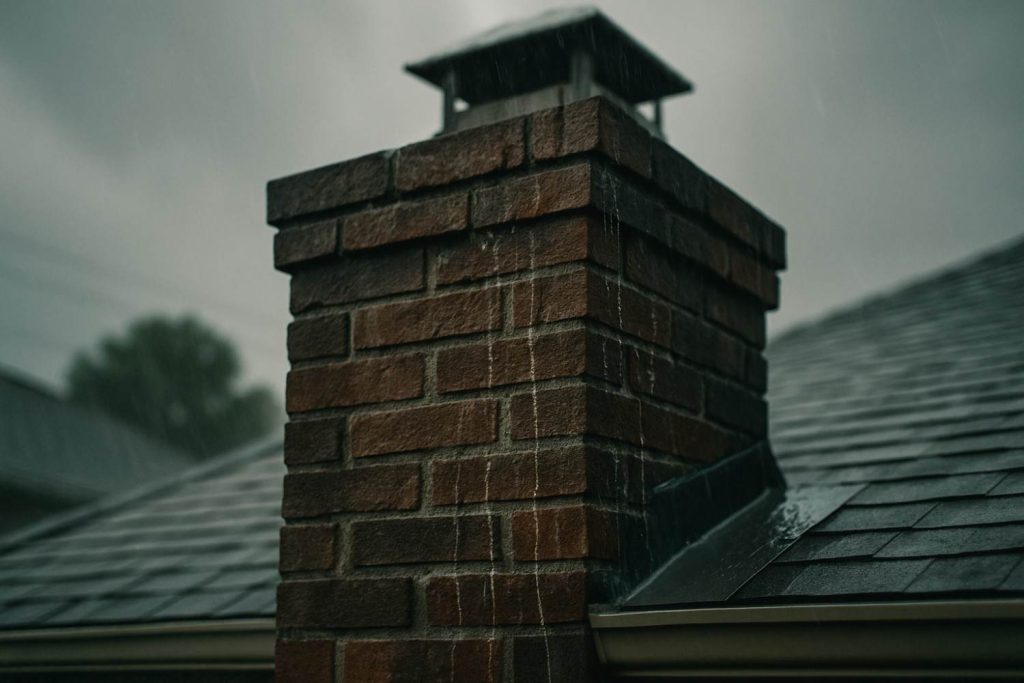
average annual rainfall in Houston
Every emergency chimney leak call follows the same quality protocol, no exceptions for speed.
✓ Temporary barrier first: Applied before the crew leaves, regardless of repair scope
✓ Full four-zone assessment: Crown, flashing, mortar joints, and flue opening, all checked, not just the visible one
✓ Step flashing inspection included: Both the exposed surface and the embedded leg at the brick face
✓ Written findings delivered on-site: Paper copy and digital record before we leave your driveway
✓ Permanent repair scoped separately: Never bundled into the emergency call without your review
✓ Materials used: Elastomeric sealant rated for Houston’s 95°F+ summer surface temperatures; galvanized or stainless step flashing stock where replacement is required; hydraulic cement for active mortar voids
Source Documented, Next Steps Confirmed
832 Home Service stops active chimney leaks the same day we arrive. We install a temporary barrier immediately. Then we document every moisture intrusion path, the specific route water travels from the chimney exterior into your home’s interior. You get a written scope before the crew leaves, so permanent repair is already planned before the next Houston storm arrives.
This is not a “schedule an estimate” situation. Every Houston rain cycle that passes through an open leak drives water deeper into the masonry. Calling now costs less than waiting.
A chimney leaking in a Houston storm usually has more than one failure point. That’s the reality of how Gulf Coast weather cycles work on masonry over time.
Here’s how we handle multi-point failures clearly. The temporary barrier addresses active water entry immediately. The written scope separates findings into what requires immediate permanent repair and what can be monitored. You don’t get a single large repair bill that bundles everything together. You get a prioritized list. If the flashing has failed and the crown has surface cracking, we tell you which one is driving the current leak and which one is approaching failure. That distinction matters for your budget and your planning.
We document everything with photographs. Every finding is labeled by location and severity. You keep that record.
Our crews have handled hundreds of emergency chimney calls across Houston. Here’s what the first twenty minutes actually look like.
On arrival, we note the roof pitch and chimney height before touching the ladder. A steep-pitch roof with a tall chimney changes the flashing geometry. Step flashing, the individual L-shaped metal pieces woven between the shingles and the chimney’s side wall, fails differently on a steep roof than on a shallow one. Step flashing can look intact from twenty feet away with a full separation at the back corner.
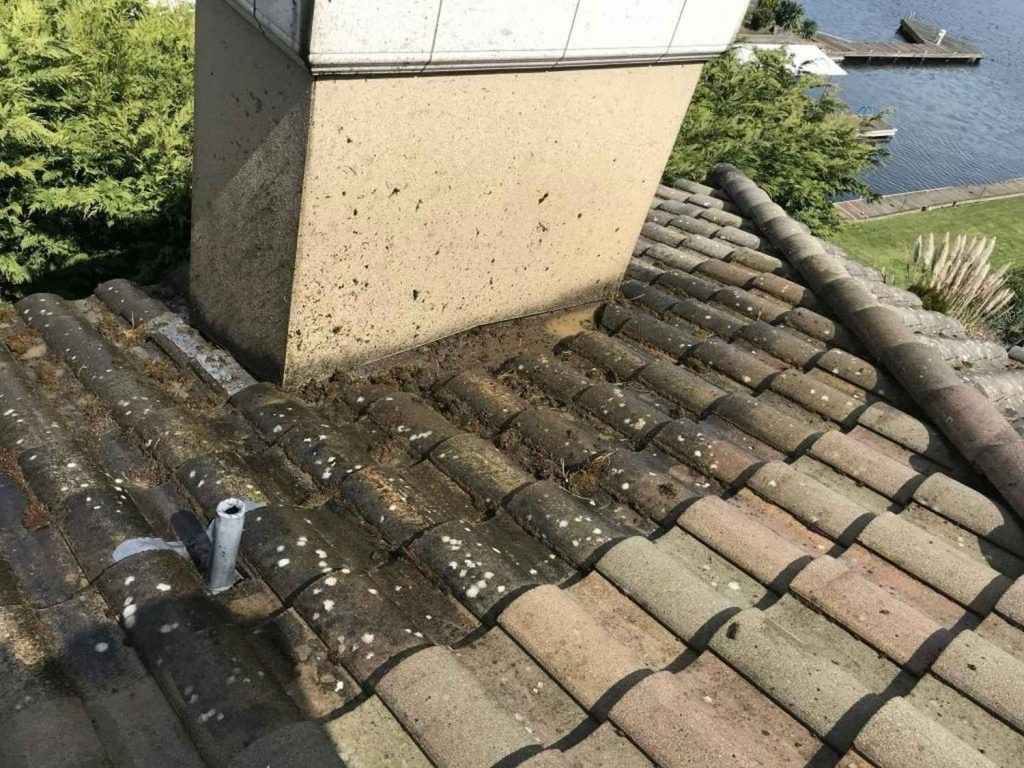
Once on the roof, we check four zones in order: the chimney crown (the concrete cap that covers the masonry shell and directs water away from the flue opening), the flashing at the base and step positions, the mortar joints in the top two courses of brick, and the flue opening itself. In a Houston storm event, all four can fail simultaneously. The crown cracks under thermal cycling. The flashing lifts when wind gets under it.
After the roof assessment, we go inside. We check the firebox for active dripping, the smoke shelf for pooled water, and the area around the firebox opening for staining that shows the leak’s direction of travel. The indoor evidence tells us which exterior zone is the primary failure point when the roof evidence isn’t definitive.
Then we install the temporary barrier, a weatherproof sealing layer applied on the service call day that stops active water entry before permanent repairs are completed. It goes on that day, regardless of whether we’re scoping a full flashing replacement or a simpler crown repair. Water stops first. Documentation follows.
Other work Houston homeowners commonly pair with this service.
Planned repair once the water has stopped.
Find and rank every entry point first.
The most common leak path on a chimney.
Keep water out once repairs are done.
Straight answers to what Houston homeowners ask us most no upsell, no hedging.
Yes. On every emergency chimney leak call, we install a temporary weatherproof barrier before the crew leaves, regardless of whether the permanent repair will involve full flashing replacement or a simpler crown repair. Water stops first, then documentation follows.
Houston averages 49 inches of rain per year, arriving in concentrated high-volume events that pressurize the chimney rather than just wetting it. Every rain cycle that passes through an open leak drives water deeper into the masonry, so calling now costs less than waiting for the next storm.
Multi-point failures are common in Houston storms. The temporary barrier addresses active entry immediately, and the written scope separates findings into what needs immediate permanent repair versus what can be monitored. You get a prioritized list, not a single bundled bill, so you know which issue is driving the current leak.
After the barrier is applied, we run a controlled water test on every treated zone using a slow stream directed at the treated surfaces. You watch the test with us. If water moves through a treated zone, we address it before leaving.
We dispatch from 2 Mockingbird Cir, Houston, TX 77074 across the Greater Houston area, including Houston, Bellaire, West University Place, Pearland, League City, Friendswood, Sugar Land, Missouri City, Pasadena, Deer Park, La Porte, Galveston, Texas City, Baytown, and surrounding communities.
(832) 662-3437
832 Home Service covers the full Greater Houston region from Galveston to Conroe, Katy to Beaumont.
If you’re not sure we reach your area, Call us.
A Houston chimney leak handled the same day costs less than one that soaks masonry through a second storm. Call 832 Home Service at (832) 662-3437 or email info@832chimneyservices.com. Tell us what you’re seeing. We’ll confirm dispatch and get a crew moving. The temporary barrier goes in today. Permanent repair gets scoped before we leave.
Contact our team today for a free consultation.
WhatsApp us
Tell us what’s going on and we’ll get back to you, often the same day.
Prefer to talk? (832) 662-3437