New liner installed and sized to the appliance connected to your chimney. Cracked terra cotta, fuel conversion, fire damage, we reline for the cause, not just the symptom.
Chimney relining installs a new liner system inside an existing flue when the original liner can no longer safely vent combustion gases.
A chimney liner, the interior channel running from the firebox to the flue opening, is the component that contains heat, directs exhaust, and keeps combustion gases from reaching surrounding wood framing. When that liner cracks, separates, or becomes inadequate for the connected appliance, the chimney is structurally present but functionally compromised.
Relining is not the same as patching. It replaces the liner entirely, or installs a new system inside the original flue structure, so the venting path is restored to full integrity. The liner type selected depends on your flue geometry, your fuel source, and the condition of the existing liner. Stainless steel flex liner, rigid stainless sections, and cast-in-place systems each serve different conditions. For a full breakdown of what each system involves, see our professional chimney liner installation options. We determine which one fits your situation before anything is ordered.
Years serving Houston
Grade stainless steel
Sealant coats per collar
Serving Houston Since 2010
Houston’s short burning seasons and high summer humidity create liner damage that builds across years, not single events.
Most Houston homes with wood-burning fireplaces burn intermittently. October through February covers the full season, and many fireplaces see only a handful of fires each year. That pattern matters because Houston’s original terra cotta tile liners, standard in homes built before 1980, were designed for consistent high-heat use. Short, infrequent fires never bring the flue to operating temperature fast enough to drive off condensation. Instead, moisture lingers inside the tile joints. To understand the full scope of this process, see our resource on how Houston’s humidity accelerates chimney deterioration.
Then Houston’s summers arrive. High humidity pushes moisture into any gap that formed during the cold season. Mortar joints soften. Tile sections shift. By the time a homeowner uses the fireplace again, a liner that appears intact from inside the firebox may have fractures running through sections invisible without a camera scan.
Here’s what most Houston homeowners don’t realize about chimney liner deterioration: the damage is not dramatic. There is no collapse, no sudden failure. The liner degrades one joint at a time, season after season, until the flue is no longer safely contained. A camera inspection to confirm liner condition is the only way to confirm what’s actually there.
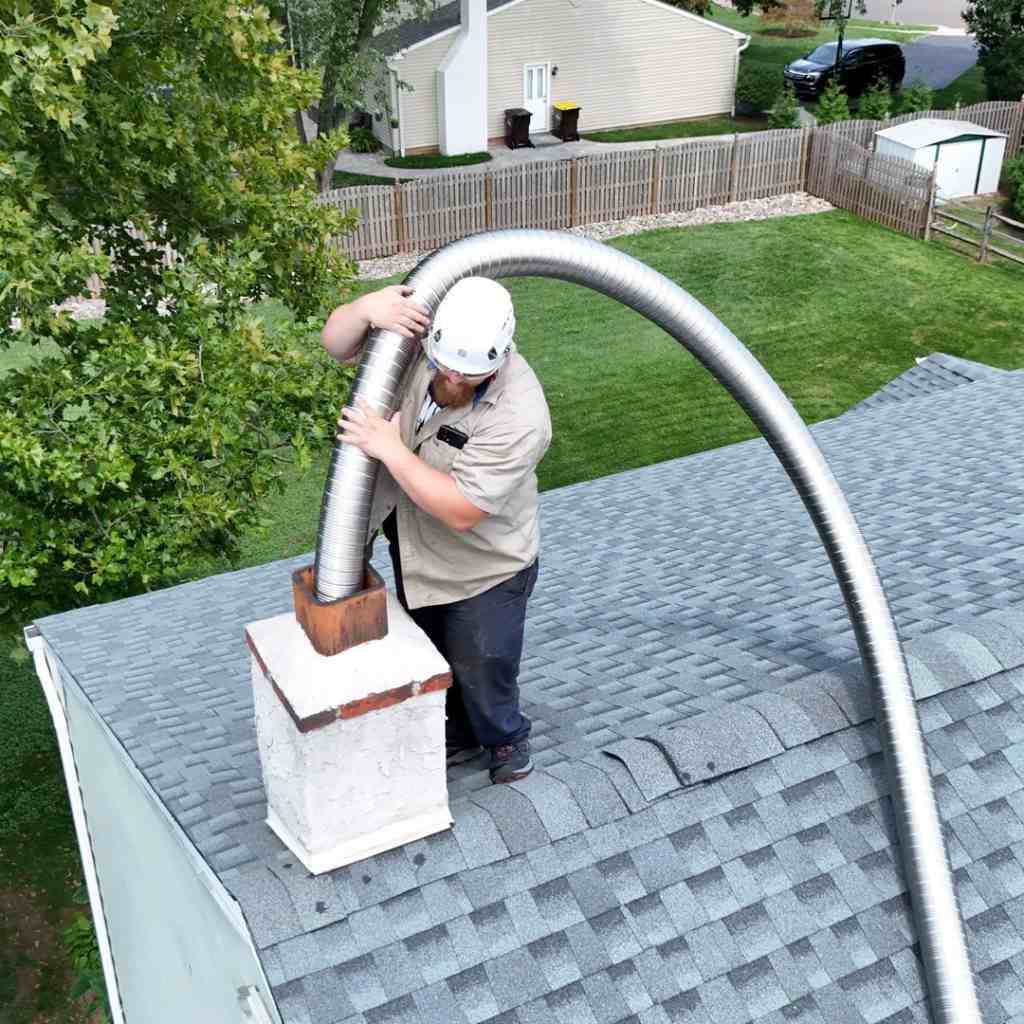
Every chimney relining we complete is sized to the connected appliance before material is ordered, not after arrival. Our approach to chimney liner replacement in Houston TX is built around a consistent set of standards:
We scope the full flue length before recommending a liner type or liner size.
Liner diameter is calculated from your appliance's output rating and flue height, not selected from a default size.
We use 316-grade stainless in coastal and near-coastal applications, where salt air in the Gulf atmosphere accelerates corrosion in thinner alloys.
Uninsulated flex liner on a high-efficiency gas appliance creates a condensation channel, insulation wrap eliminates it.
Wood appliances and gas appliances require different termination cap specifications.
Liner dimensions, appliance specifications, liner grade, and installation date, documented and delivered to the homeowner.Three coats of sealant at all liner collar connections. Not one. Not two.
The process for a complete chimney relining begins with the camera, and ends with a smoke or pressure test before we leave.
The first step is a full camera scan of the existing flue. We run the scope from the firebox collar to the flue cap, mapping every section. We document joint separation, tile fractures, offset geometry, and smoke chamber condition. If the smoke chamber has deterioration that affects liner seating, we identify it here, before the liner is ordered. Liner diameter and type are selected from the diagnostic findings and the connected appliance's specifications.
On installation day, the old liner components are removed or stabilized where removal would affect the surrounding masonry. The new liner is measured, cut, and prepared at ground level before it goes up. Flexible systems are assembled with the lower connection fitted first, at the smoke chamber collar, then pulled upward. Rigid sections are joined from the top down. An insulation wrap is applied where the appliance type or flue geometry requires it. The termination cap is fitted and secured before any connection below is finalized. Liner position is confirmed with the camera before the cap is locked down.
After the liner is installed, we perform a functional draft test with the connected appliance active. For wood-burning applications, we use a smoke match test at the firebox opening and smoke chamber. For gas appliances, we perform a draft pressure test at the appliance connection collar. CO levels are spot-checked at the firebox and near the appliance. Written project documentation, liner type, diameter, grade, installation sequence, and test results, is completed before we leave the property.
The liner type that fits your chimney is determined by your flue’s geometry, your appliance’s BTU output, and the existing liner’s condition.
One of the most common questions we get: “Can’t you just put in the flexible stainless liner?” Sometimes yes. Sometimes no. Here’s the honest answer above. When deterioration extends into the surrounding masonry structure itself, relining alone may not be sufficient, see our page on full chimney repair when relining alone isn’t enough for those situations.
Here’s the important part: oversizing a liner on a gas appliance causes condensate buildup inside the flue. Undersizing restricts draft. We run the BTU calculation for your specific appliance before selecting liner diameter. That calculation is part of the assessment, it is not a judgment call made on the roof.
The right choice for most older masonry flues with gentle offsets, existing deterioration, and wood-burning or mid-efficiency gas appliances. Installs without tearing out original tile, durable, and the fastest path to a serviceable flue in most Houston homes.
A severely offset flue, common in Houston's pre-war bungalows where chimneys were built around existing framing, may require rigid stainless sections through the straight runs.
A flue with complete structural deterioration, particularly after a chimney fire, may require a cast-in-place liner poured against the existing masonry to form a seamless smooth-bore channel.
Houston’s housing stock has shifted heavily toward gas appliances, and many fuel-conversion projects treat the existing chimney as a ready-made shortcut. It isn’t.
Gas appliances produce exhaust at lower temperatures and with higher moisture content than wood fires. A liner oversized for a gas appliance lets that moisture-laden exhaust cool and condense before it exits the flue, leaving acidic condensate the corrosive liquid formed when cooled gas exhaust meets a liner wall against your masonry every time the appliance runs. In Houston’s humidity, correct sizing isn’t optional.
That’s why every liner we install starts with appliance-matched sizing, before any material is ordered: sizing calculation, liner type selection, installation, and a documented project record.
A new liner applies if you are:
All liner work requires a Tier 2 chimney inspection first, to confirm the flue’s condition and verify the selected liner type suits the existing structure. The CSIA homeowner resources offer further reference on when a liner is required.
Homes across the Inner Loop, West University Place, Bellaire, and Meyerland are the most active market for this work 1950s and 60s wood-burning chimneys converted to gas as kitchen and living-room remodels continue.
Have questions about pricing before scheduling? See our guide on what chimney relining typically costs in Houston for a breakdown of what affects the final number.
When a liner has separated joints or fractures running through multiple sections, relining is the correct fix, patching only masks the symptom. We confirm the extent with a full camera scan before recommending relining rather than repair, because you cannot size a liner to a problem you haven’t fully mapped.
The liner type is determined by your flue’s geometry, your appliance’s BTU output, and the condition of the existing liner. Flexible stainless suits most older masonry flues, rigid stainless handles severely offset flues, and cast-in-place is used for complete structural deterioration. We run the BTU calculation before selecting diameter.
Houston’s short burning seasons and high summer humidity create damage that builds across years, not single events. Infrequent fires never reach operating temperature fast enough to drive off condensation, and summer humidity pushes moisture into any gap. The liner degrades one joint at a time, often invisible without a camera scan.
We use 316-grade stainless in coastal and near-coastal applications, where salt air in the Gulf atmosphere accelerates corrosion in thinner alloys. All stainless is specified to gauge and grade for your specific installation.
We schedule the diagnostic camera scan visit first, then confirm the right liner type. For most Houston-area homes we complete the installation in a single follow-up appointment, including a functional draft test and written documentation before we leave.
(832) 662-3437
832 Home Service completes chimney relining across Harris County and throughout the surrounding metro area. If your chimney’s deterioration extends beyond the liner itself, see our full chimney repair when relining alone isn’t enough service for situations involving structural masonry, crown, or exterior flue damage.
832 Home Service relines Houston chimneys sized to the appliance, not to a default liner diameter pulled off the truck. Full liner replacement systems engineered to your flue geometry, fuel source, and appliance output, delivered across the greater Houston region. Call 832 Home Service at (832) 662-3437 or email info@832chimneyservices.com
WhatsApp us
Tell us what’s going on and we’ll get back to you, often the same day.
Prefer to talk? (832) 662-3437