When the damper is open and the flue is clear but smoke still spills into the room, the smoke chamber is the next step. We assess, document, and repair with refractory mortar in a single visit.
A properly parged smoke chamber funnels combustion gases from the wide firebox into the narrower flue without turbulence. The smoke chamber is the funnel-shaped cavity directly above your firebox. It compresses combustion gases from the wide firebox opening into the narrower flue diameter above. When that chamber has a smooth, intact interior – what’s called a parge coat – gases transition upward cleanly. If you’re experiencing persistent venting problems, our chimney relining services in Houston address issues that extend from the smoke chamber up through the flue above. When the parged surface cracks or deteriorates, that smooth path breaks down. Gases slow. They spread. They spill forward into the firebox opening and enter your living space before the draft can pull them up.
Here’s what most homeowners don’t realize about that situation: the damper and flue get checked because they’re the obvious culprits. The smoke chamber sits just above the firebox – rarely seen, almost never discussed – and it’s the component doing the real transitional work. When its surface fails, nothing upstream or downstream explains the symptom. A chimney draft analysis to identify venting problems can help confirm where the failure originates before a repair recommendation is made.
832 Home Service inspects the smoke chamber on every smoke-spillage diagnostic call. Light and mirror. Full surface check. Before any repair recommendation is made, we also offer a Tier 2 chimney inspection for smoke issues that documents the complete interior surface condition.
Full interior surface check on every smoke-spillage call.
Heat-rated material, no standard masonry substitution.
Serving Greater Houston
Documented condition report at every visit close.
Corbeled smoke chambers in pre-1970 Houston masonry are showing parging failure on a wide scale.
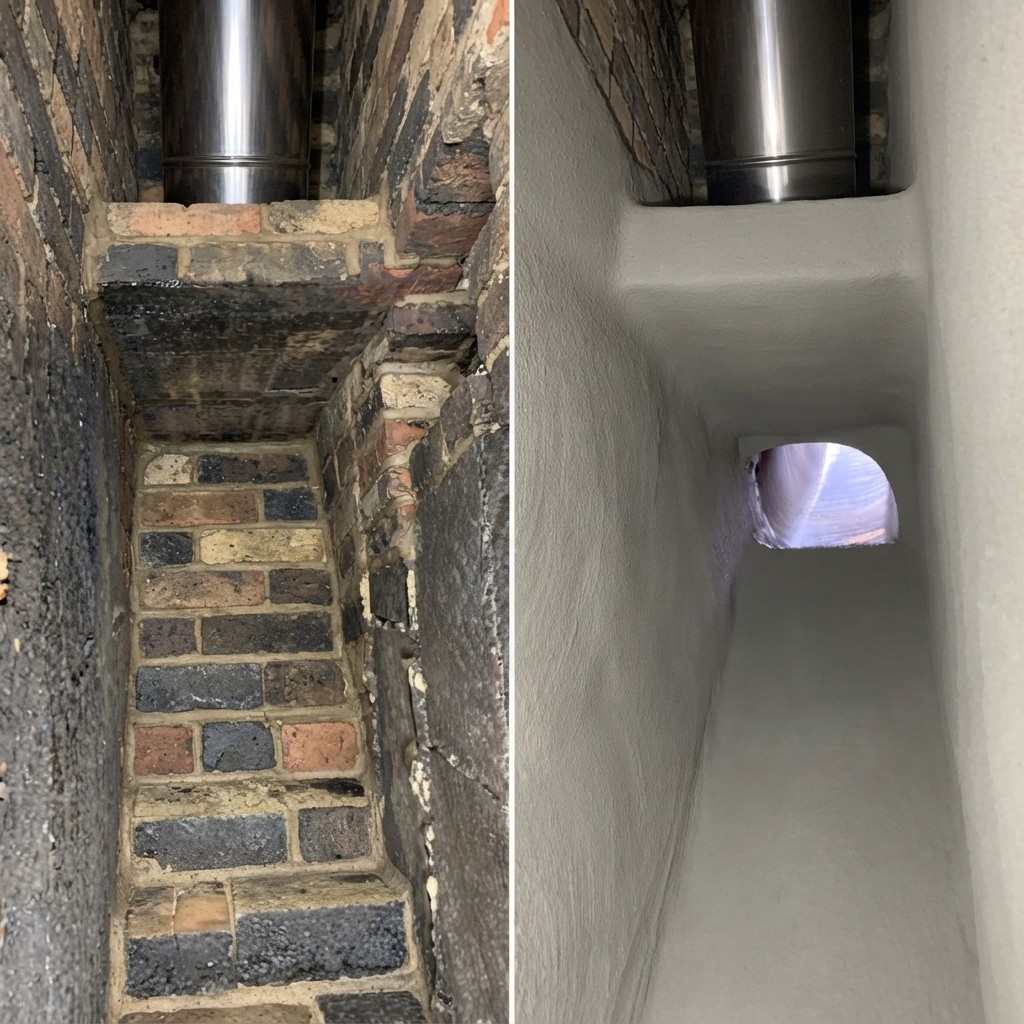
A corbeled smoke chamber is the traditional construction method – brick courses step inward toward the flue opening, creating a rough, stair-step interior. That surface requires parging: a refractory mortar coating that smooths the steps into one continuous curved surface.
In Houston’s Montrose, Midtown, and Museum District neighborhoods, 1930s through 1950s masonry fireplaces with original corbeled chambers are now at 70 to 90 years of age. Many were used for decades, then converted to gas logs, then converted back to wood-burning use in the last 15 years. That cycle of use, dormancy, and return to service accelerates parging deterioration. Aged corbeled chambers in this condition often require full chimney repair when multiple components are failing to address the full scope of deterioration beyond the smoke chamber alone.
Houston’s climate contributes, too. The city’s roughly 50 inches of annual rainfall and high summer humidity keep masonry interiors intermittently wet – learn more about how Houston’s humidity accelerates masonry deterioration. Thermal cycling brief winter fires in an otherwise warm climate – creates contraction and expansion stress that works on cracked parging surfaces faster than in a cold-climate fireplace burning daily through a four-month season. The result is a large number of inner-city Houston fireplaces with smoke chambers that are partially or fully unparged, actively causing smoke spillage, and misdiagnosed as flue or damper problems.
Learn more about combustion products and indoor air quality to understand the importance of maintaining a safe indoor environment.
Refractory mortar is required for smoke chamber work standard masonry mortar degrades under direct combustion heat.
Full interior surface assessed before any parging begins - corbel exposure, crack map, and parging condition documented
Smoke shelf inspected as part of every chamber assessment - debris accumulation on the smoke shelf disrupts airflow where it enters the chamber; creosote buildup inside a deteriorating smoke chamber is documented and addressed before parging begins.
Cure time respected before the fireplace is returned to use - typically 24 to 72 hours depending on material and ambient conditions
Refractory mortar selected to match the heat exposure of the specific chamber - no substitution of standard masonry mortar
Parge coat applied in smooth, continuous strokes to eliminate the step profile of corbeled smoke chambers
Written findings delivered at the close of every inspection and repair visit
Every smoke-spillage assessment at 832 Home Service produces a written description of the smoke chamber surface.
Some homeowners wonder whether a surface they can’t see is actually being inspected. That’s a fair question. Here’s how we handle it.
After every smoke chamber inspection, you receive a written description of what the chamber surface looks like – parging condition, corbel exposure, crack locations, and the direct connection between what we found and the smoke spillage you reported.
If parging repair is recommended, you understand why before work begins. If the chamber is intact and the problem is elsewhere, you know that too. No repairs are recommended without a confirmed chamber finding to support them.
That written summary isn’t an estimate. It’s a record of what we found the specific condition data that makes the repair decision a clear one.
We’ve been doing this across Houston since 2010. The call that comes in most often on smoke chamber jobs starts the same way. The homeowner says: “We opened the damper all the way and the smoke still came into the room. We had someone look at the flue and it’s clear.”
That’s exactly the right set of checks. Finding them clear narrows it down fast. Last season we had a call from a homeowner in the Museum District a 1941 brick fireplace used lightly for years. The previous owner had cleaned it a couple of times but never had the smoke chamber inspected. Our first step was to confirm damper function and flue condition. Both were fine.
Then we went into the smoke chamber with a light and mirror. The original parging was almost entirely gone. What remained was crumbling at the edges. The corbeled steps those stair step brick courses were fully exposed. That rough, irregular surface was creating draft turbulence: the disruption of smooth upward airflow caused by irregular chamber surfaces. Gases were slowing and spreading forward into the firebox opening instead of compressing into the flue.
The repair was parging. Refractory mortar a heat-rated mortar formulated for smoke chamber temperatures applied to the full chamber interior in a smooth, continuous coat. After cure, the homeowner lit a test fire. Draft was clean. No spillage. Written report delivered the same day.
Full Interior Surface Mapped Before Any Repair Discussion The inspection begins with the firebox - damper operation, firebox dimensions, smoke shelf condition. Then the smoke chamber is accessed with a light and mirror. The full interior surface is mapped: what is parged, what has deteriorated, where the corbeling is exposed, and where cracks run. This is documented before any repair discussion.
Refractory Parging Applied to the Full Chamber Surface.Smoke chamber parging the application of refractory mortar to create a smooth, continuous interior surface begins after the assessment is complete and the findings are reviewed. The smoke shelf is cleaned first. Chamber surfaces are prepared. Refractory mortar is applied to the full interior, covering any exposed corbeling and filling all cracks and gaps. The chamber profile is shaped to guide gases smoothly into the flue opening above.
Draft Confirmed Before the Visit Closes.After the required cure period - confirmed based on the mortar used and ambient humidity - a test fire is conducted. Draft behavior is observed at the firebox opening. Clean upward draw with no smoke spillage confirms the repair. The homeowner receives a written summary of pre-repair condition, work performed, material used, and post-cure test results.
When the damper and flue are both clear, the smoke chamber above the firebox is the next component to check. A deteriorated or unparged chamber surface creates draft turbulence that slows gases and pushes them forward into the room before the draft can pull them up.
Parging is a refractory mortar coating applied to the interior of the smoke chamber. It smooths the rough, stair-step corbeled brick into one continuous curved surface so combustion gases transition cleanly from the wide firebox into the narrower flue above.
Standard masonry mortar degrades under direct combustion heat. Smoke chamber work requires refractory mortar, a heat-rated material formulated for the temperatures a chamber sees. We never substitute standard mortar in this application.
Cure time is respected before the fireplace is returned to use, typically 24 to 72 hours depending on the material used and ambient conditions. After the cure period, we conduct a test fire to confirm clean draft before the visit closes.
Yes. Every assessment produces a written description of the chamber surface, including parging condition, corbel exposure, and crack locations. After repair, you receive a written summary of pre-repair condition, work performed, material used, and post-cure test results.
Cost depends on the extent of parging failure and chamber condition. For a breakdown of what to expect before you call, see our smoke chamber repair cost estimates for Houston homeowners.
(832) 662-3437
832 Home Service performs smoke chamber repair across Houston and the surrounding metro.
Contact our team today for a free consultation. Call 832 Home Service at (832) 662-3437 or email info@832chimneyservices.com to schedule your assessment.
If smoke is entering the room and the damper and flue have already been checked, the smoke chamber is the next step. We assess the full chamber interior, document what we find, and complete parging repair with refractory mortar in a single visit when surface condition allows.
WhatsApp us
Tell us what’s going on and we’ll get back to you, often the same day.
Prefer to talk? (832) 662-3437