Crown, liner, flashing, mortar assessed together, repaired together, quoted before work starts. When your Houston chimney has multiple failing parts, a complete repair scope from 832 Home Service addresses all of it before work starts. One coordinated project, one quote, every failing component handled together.
Thirty-to-forty-year-old chimneys in Cypress, Tomball, and Brookshire are hitting compound deterioration all at once. Post-1985 construction along the US-290 northwest corridor was built during a period when prefab metal chase systems were common. Those chase covers are now corroding, letting water into the chase framing. Meanwhile, original masonry crowns on homes that did use brick construction have reached the age where Houston’s thermal cycling has worked surface cracks into substrate cracks.
832 Home Service has performed full chimney repair projects across the Houston metro since 2010. Our crews have direct experience with the deterioration patterns specific to this housing stock – including accelerated mortar erosion in pre-1970 Pasadena and Baytown homes and the chase cover failures typical in post-1990 Katy and Cypress construction.
The masonry deterioration timeline here moves faster than in drier Texas climates. Fifty inches of annual rainfall and cycling humidity are not mild conditions for masonry. Understanding how Houston’s humidity accelerates chimney deterioration helps explain why homeowners in Pasadena, Baytown, Katy, and Cypress so often face compound damage rather than isolated failures.
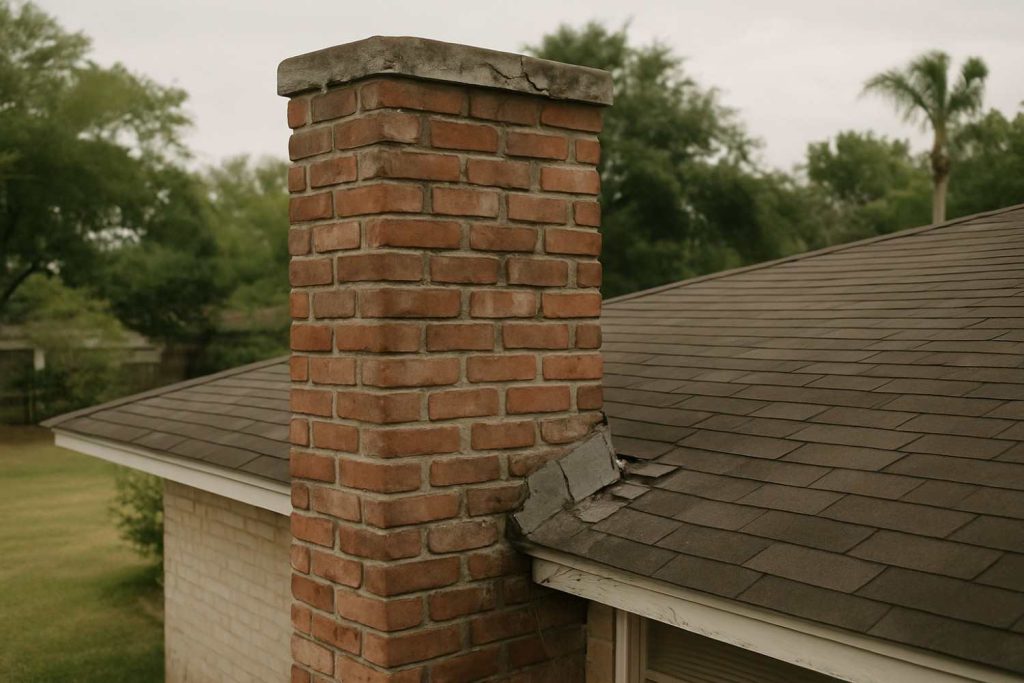
Full chimney repair means every failing component is identified, scoped, and quoted before a single tool touches the structure.
This isn’t a single-component service. It’s the right approach when a chimney has experienced compound chimney deterioration – the condition in which multiple components fail simultaneously because an early failure allowed water or heat to stress the rest of the system.
Crown cracks first. Rain follows the crack into the mortar joints. Mortar softens. Bricks begin to pull moisture and spall. Flashing lifts at one corner because the masonry beneath it has shifted. The liner picks up stress fractures from thermal cycling through a now-unsupported structure.
By the time a Houston homeowner notices something wrong, there is rarely just one problem to fix.
A full chimney repair project addresses all of it in a single coordinated scope – assessed together, quoted together, completed without mid-project additions.
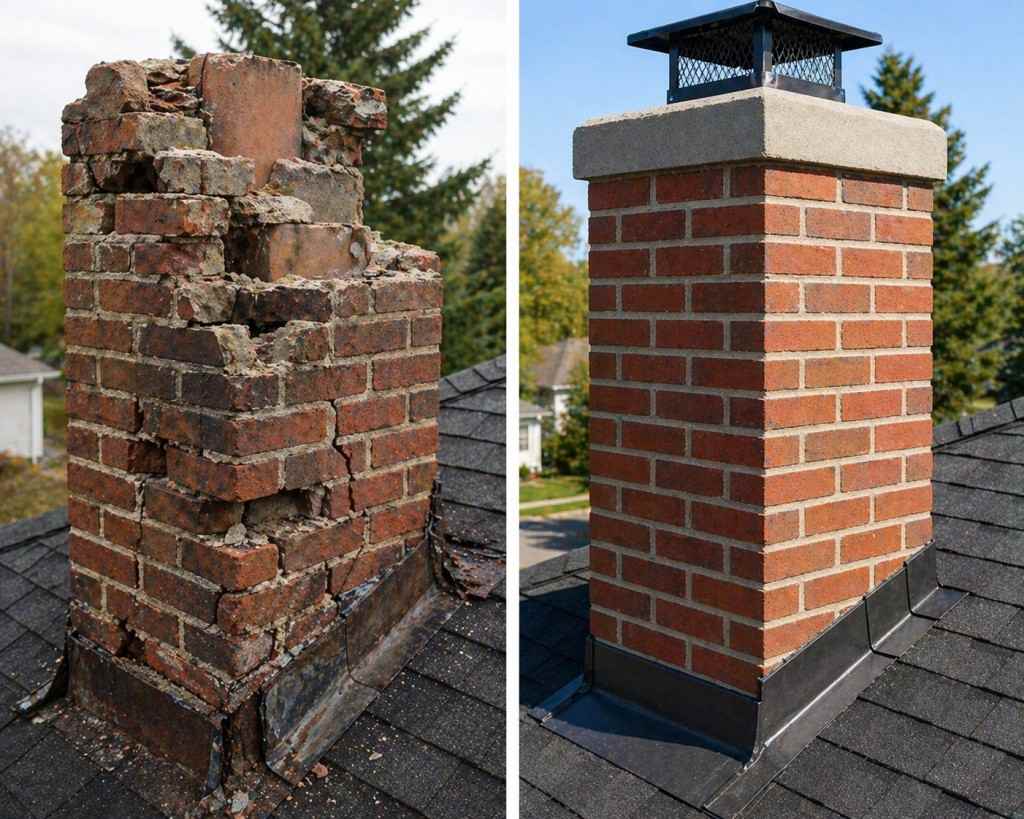
Every material choice, sequencing decision, and documentation step follows a defined standard.
Mix type is matched to the chimney's age and existing masonry. Portland cement in a lime-mortar chimney cracks the adjacent brick. We identify the original mix before touching a joint.
Every full repair scope includes a documented liner crack log. We do not skip liner documentation on exterior-only repairs.
Structural work first - crown, liner, masonry. Waterproofing last, after every repaired surface has cured.
Replacement crowns are formed with a minimum 2.5-inch overhang on all four sides - the dimension that sheds Houston's rainfall away from the brick face below.
Mechanically fastened two-part flashing only. Sealant-only flashing fails under Houston's thermal roof movement. Where water intrusion has already compromised surrounding masonry, we also address chimney leak repair as part of a full scope - not as a separate follow-up call.
Written repair scope with component-level findings delivered before work starts. No verbal summaries.
Here’s what a multi-system repair call typically reveals and why addressing the bottom first misses everything above it.
From Marcus at 832 Home Service:
I got a call from a homeowner in Pasadena last year. She had noticed soft mortar at the base of her chimney maybe a four foot stretch where the joints had receded noticeably. Her first instinct was to get those joints repointed and move on. I climbed the roof before agreeing to anything. What I found was a crown with a lateral crack running almost the full width not a hairline, a structural substrate crack. That crack had been channeling water directly into the brick face for at least two seasons. The mortar erosion she noticed at the base was downstream damage. The source was four feet above the roofline.
Here’s what that cause and effect chain looked like, top to bottom:
The crown cracked likely from Houston’s summer to winter thermal swing working on an overhang that was never formed to the minimum 2.5-inch standard. That let water onto the brick face. The brick face saturated repeatedly, weakening the mortar bed. Flashing failures that allow water intrusion had also occurred at the northeast corner, where the flashing had separated slightly, probably from masonry movement. The liner showed hairline fractures at the upper section – consistent with prolonged moisture contact.
Repointing the base would have addressed the visible damage while leaving four upstream failure points untouched. Each one would have continued stressing those new joints within two seasons. We recommend a comprehensive chimney inspection before repairs begin precisely because this kind of top-to-bottom cause-and-effect chain only becomes visible through systematic documentation of every zone not a visual estimate from the ground. We scoped the full repair crown replacement, mortar repointing from crown to roofline, flashing reinstallation at the northeast corner, and liner assessment with a documented crack log and delivered a single quote covering all of it before a single joint was touched.
That’s the difference between a piecemeal repair addressing one component without evaluating the whole system and a multi-component repair that resolves the actual source of deterioration.
Every component is assessed and every cost is confirmed before our crew does a single thing to your chimney.
This is the part that matters most when a repair involves multiple failing systems.
When 832 Home Service scopes a full chimney repair, the repair scope assessment a pre-work evaluation of every chimney component happens before the repair plan is written. Not after the crew gets started. Before.
The homeowner receives a written scope naming every component being addressed and explaining why. The cost tied to that scope is confirmed before work begins. Nothing is added mid-project. Homeowners who want to understand what full chimney repair costs in Houston before committing to a scope will find that our pre-work quoting process aligns directly with that need – every line item is disclosed upfront.
The sequence of repairs matters as much as the repairs themselves. Waterproofing applied before repointing traps moisture behind the seal. Liner work completed before crown replacement exposes the new liner to another water cycle before the source is stopped. We work in the correct order every time.
Every repair engagement begins with a structural chimney assessment - not a visual estimate. We inspect the chimney from cap to foundation: crown condition, mortar joint depth, brick face integrity, flashing attachment, and liner status. Findings are documented by zone. The structural chimney assessment determines whether component-level repairs can preserve the existing structure - or whether a chimney rebuild, a partial or full masonry reconstruction, is required. The written scope and quote are produced from this assessment. Nothing is added after the homeowner approves the scope.
Repairs execute in sequence. Structural masonry work comes first - crown replacement or repair, mortar repointing and joint repair, brick face work, liner repair or relining. Flashing reinstallation follows masonry work. Waterproofing and sealing are completed last, after all repaired surfaces have reached full cure. Material selections are confirmed at the assessment stage. Brick replacement involves sourcing matched replacements before any spalled face is removed - color, size, texture, and hardness all verified. No on-site substitutions without homeowner notification
After implementation, every repaired component is verified before the crew leaves. Liner integrity is confirmed. Flashing is checked for mechanical attachment at all contact points. Crown overhang and slope are measured. Mortar joint depth is spot-checked against the pre-repair baseline. A post-service written summary is delivered covering what was repaired, what materials were used, and the condition of each component at project close. No verbal walkthrough only.
Full chimney repair is a coordinated project, not a series of one-off fixes. Here is how a complete repair scope comes together from the first assessment through final verification.
Every repair begins with a structural chimney assessment - not a visual estimate. We inspect from cap to foundation and document findings by zone.
Repairs execute in sequence. Structural masonry first, flashing next, waterproofing last - after every repaired surface reaches full cure.
Every repaired component is verified before the crew leaves. A written summary covers repairs, materials, and each component's condition.
A full chimney repair addresses every failing component in one coordinated scope after a top-to-bottom assessment. Component-specific work fixes only what is visible, which often leaves upstream failure points untouched and continuing to cause damage.
Yes. The repair scope assessment happens before the repair plan is written. You receive a written scope naming every component and the confirmed cost tied to it before our crew touches your chimney. Nothing is added mid-project.
Sequencing prevents wasted work. Waterproofing applied before repointing traps moisture behind the seal, and liner work completed before crown replacement exposes the new liner to another water cycle. We complete structural work first and waterproofing last, after all surfaces have cured.
Fifty inches of annual rainfall and cycling humidity stress masonry faster than in drier Texas climates. In areas like Pasadena, Baytown, Katy, and Cypress, one early failure such as a cracked crown routes water into mortar, brick, flashing, and liner, producing multiple failing components at once.
Yes. Every repaired component is tested at project close – liner integrity, flashing attachment, crown overhang and slope, and mortar joint depth. You receive a written post-service summary detailing repairs, materials, and each component’s final condition.
(832) 662-3437
832 Home Service performs preventive chimney inspections across the Greater Houston area.
One assessment. One quote. Every component addressed before work begins.
If your Houston chimney has visible damage in more than one location, or if previous repairs haven’t resolved the underlying problem, a full repair scope is the right starting point. Call 832 Home Service at (832) 662-3437 or email info@832chimneyservices.com to schedule your repair scope assessment. Once repairs are complete, we encourage homeowners to review the EPA Burn Wise program for safe fireplace operation to ensure your restored chimney system is used correctly from day one.
WhatsApp us
Tell us what’s going on and we’ll get back to you, often the same day.
Prefer to talk? (832) 662-3437