Custom Concrete Chimney Crown Installation in Houston, TX
Formed, poured, and sealed to the correct dimensions for your chimney. Not close to spec. To spec.
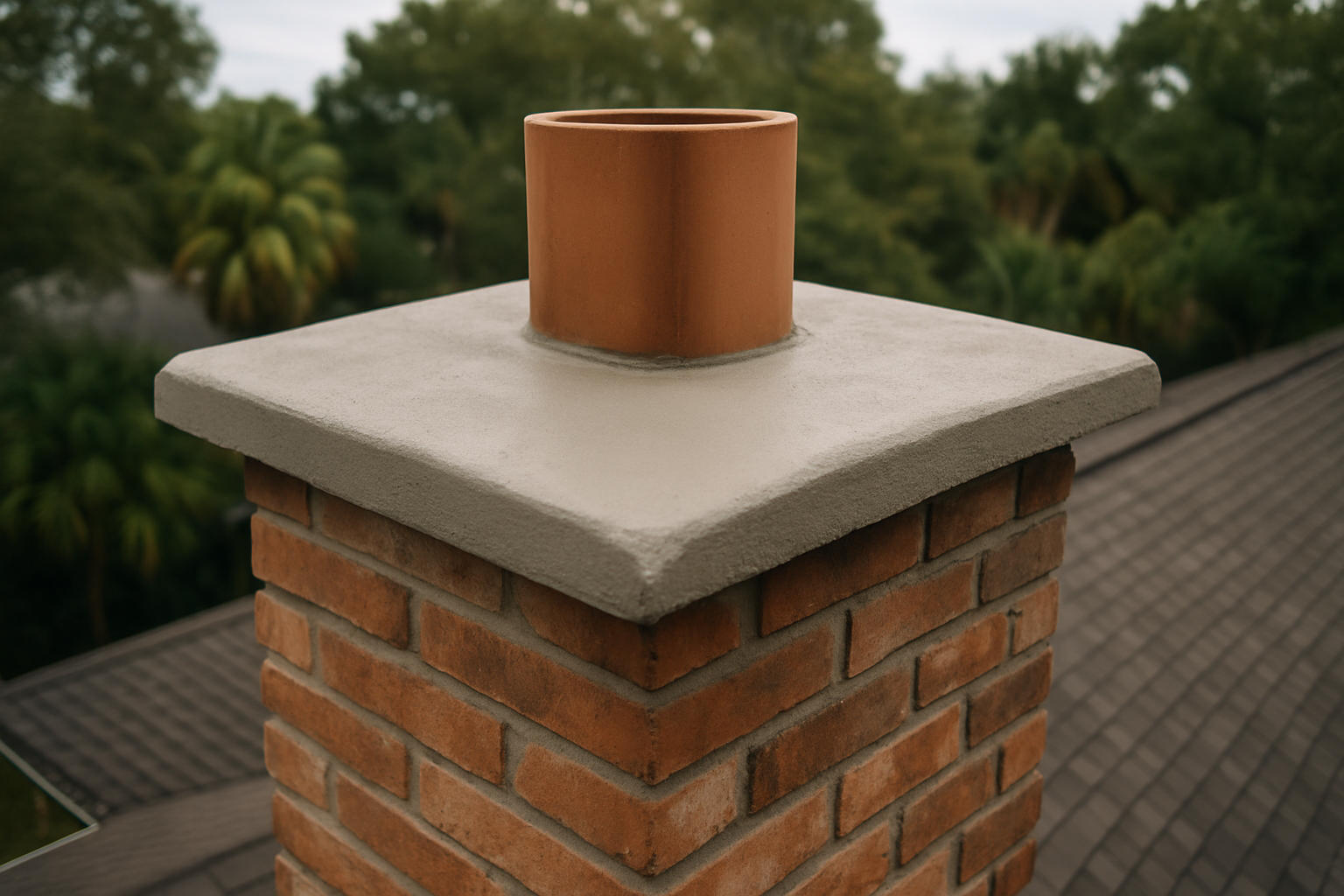
Custom Concrete Chimney Crown Installation — Houston, TX
A crown built on-site to the exact dimensions of a single chimney. Correct overhang, correct slope, sealed flue collar. Every time.
A Custom-Formed Crown Built to Spec — Overhang, Slope, and Flue Collar Seal
A correctly built chimney crown has three non-negotiable specifications: overhang, slope, and a sealed flue collar.
That's not a style preference. Those three details determine whether your crown sheds water away from the chimney or holds it against the brick.
The custom-formed chimney crown — a concrete crown built on-site to the specific dimensions of a single chimney, rather than adapted from a pre-formed or patched shape — is the only type of crown that can reliably meet all three specifications. Here's why each one matters.
The standard requiring a crown to extend at least 2 inches beyond the outer edge on all four sides. The correct target is 2.5 inches. That extension creates a drip edge — causing water to drip free rather than run down the chimney face. Without correct overhang geometry, water intrusion damage from a failed crown becomes likely with every significant rain event. See the CSIA homeowner guidance on chimney crown requirements.
The intentional tilt of the crown surface away from the flue collar toward the outer edges. It ensures standing water cannot pool at the crown's highest point. A flat-topped crown turns every Houston rain event into a standing-water problem.
A minimum of 2 inches at the outer edge resists the thermal cycling that cracks thin crowns at the perimeter. That's where most crown failures begin.
The joint between the crown and the flue liner tile. A critical waterproofing point that must accommodate thermal movement. Without a correctly formed seal, that joint opens under heat and allows water entry at the most vulnerable point on the chimney. Pairing a new crown with waterproofing the chimney after crown installation adds protection here.
832 Home Service forms every replacement chimney crown to these specifications. Not close to them. To them.
Replace a Failed Crown With One Built to the Right Dimensions, Not a Stock Shape
A crown that fails because it was incorrectly formed the first time deserves a correctly formed replacement.
Many Houston homeowners assume a failed crown is simply a worn crown. But the original crown on a significant number of Houston homes was incorrectly formed from the start. Too thin at the edges. Flush with the chimney face, with no overhang at all. A flat or slightly pitched top that collects water instead of shedding it.
Here's what most homeowners don't realize about chimney crown failure: the shape of the crown, not just its age, determines its lifespan. In some cases, it's also worth evaluating chimney crown repair before full replacement to determine whether the existing structure can be correctly reformed or must be removed entirely.
When a flat-topped, flush-edged crown fails after 15 years, it doesn't tell you the concrete wore out. It tells you the design spec was wrong. Replacing it with the same design — same dimensions, same flat profile, same flush edge — produces the same result on roughly the same timeline. The concrete isn't the problem. The geometry is.
This matters specifically in The Woodlands, Spring, and Conroe, where rapid residential development in the 1990s and 2000s produced large volumes of builder-grade crowns that are now hitting or past their failure age. Understanding how Houston's humidity accelerates chimney crown deterioration helps explain why so many of these builder-grade crowns are failing simultaneously across the region. When those crowns are removed, 832 Home Service does not recreate the original shape. A replacement crown installation — starting from a cleared chimney top and building to correct specifications from the base up — is how we approach every failed-crown job. The replacement is built to the correct dimensions for that chimney, not adapted from a universal form or sized to what was there before.
The chimney gets a crown it deserves. Not one it had.
Crown dimensions are not standardized. Chimney tops vary by width, depth, flue count, and flue collar diameter. Before any material comes off the truck, we measure your chimney top — both directions, the flue collar, the existing chimney face below the crown seat. Those measurements go into the form design. The form is built to your chimney's dimensions that morning. The crown that results fits your specific chimney, because it was shaped around it. That's the correct way to build a chimney crown.
Our Standards for Custom Concrete Crown Installation
Every crown we install meets a documented specification — overhang, thickness, slope, and seal all confirmed before we leave.
Our installation standards are consistent across every chimney crown job in the Houston metro:
- ✓Minimum overhang: 2.5 inches on all four sides — measured and confirmed before forming
- ✓Crown slope: Minimum 10-degree pitch from flue collar to outer edge on all sides
- ✓Minimum crown thickness: 2 inches at the outer edge, thicker at the crown center
- ✓Flue collar seal: Flexible joint formed between concrete and flue tile to allow thermal movement
- ✓Drip edge undercut: Formed on the underside of the crown perimeter to break water free before it reaches the chimney face
- ✓Curing window: Minimum 48-hour wet cure under cover before sealant application
- ✓Sealant type: Vapor-permeable masonry repellent only — no film-forming product that traps residual moisture inside the concrete
No pre-formed or universal-fit crown components. No mortar patches over the original failed crown surface. Every installation starts from a cleared chimney top.
The Crown Installation Process — From Chimney Top to Final Seal
Custom concrete chimney crown installation follows a specific sequence — each step depends on the one before it.
Crown Removal and Chimney Top Assessment
Before any forming begins, the failed crown must be fully removed. We do not resurface over a failed crown. Surfacing over an existing failed crown traps water and active cracks behind the new layer.
Once the crown is off, we assess the chimney top. We check the flue tile condition at the collar. We look for mortar joint deterioration along the top course of brick — any damaged mortar is repointed before the form goes up. Crowns without proper overhang geometry also contribute to mortar joint damage caused by crown runoff, which is why we address any existing deterioration at this stage before forming begins. The chimney top is cleaned and dampened to improve concrete bond.
We document the chimney top dimensions in both directions and the flue collar diameter. These measurements drive the form design.
Crown Forming and Pour
The wooden form is built on-site to deliver the correct overhang on all four sides. The interior of the form is sloped. A pre-formed flexible sleeve is installed at the flue collar joint before the pour begins.
We mix the concrete to a mid-range water-to-cement ratio — wet enough to consolidate fully, stiff enough to hold the formed slope without slumping during the pour. After placement, we consolidate with a vibrating tool to eliminate air pockets along the form edges. The surface is struck off to the sloped profile and finished.
Curing and Post-Installation Seal
The crown cures under wet burlap or a curing blanket for a minimum of 48 hours. Curing under cover is standard regardless of weather conditions. Houston's heat accelerates surface drying and can cause shrinkage cracking if the crown is not kept moist during the early cure window.
After the cure period, we apply a vapor-permeable masonry sealant to the crown surface and the top course of brick below it. The sealant penetrates the concrete surface without forming a film. This allows any residual moisture to exit while blocking new water entry.
We confirm the drip edge is fully formed and undercut before sealing is complete. Final photos of the finished crown are included in the service record.
New Concrete Chimney Crown Formed, Poured, and Sealed in a Single Scheduled Visit
A field account from the 832 Home Service team — Houston, TX
We got a call from a homeowner in Spring last fall. Their crown had been removed — correctly — after a post-storm inspection found it was cracked through to the flue collar. They'd had it pulled off by a general contractor who then told them to find a chimney company for the replacement. Smart call.
When I got up on the roof, the chimney top was fully exposed. The original crown had been flush with the face on two sides and had maybe a half-inch of projection on the other two. There was a groove where the flue collar met the concrete — or rather, where it didn't. That joint had never been properly formed. It was just concrete butted against the flue tile.
We measured the chimney top in both directions and documented the flue collar diameter. Then we built the form. The form is what makes a custom crown actually custom. We set it to deliver 2.5 inches of overhang on all four sides, with the interior pitched toward the edges at approximately 10 degrees. The flue collar seal was pre-formed as a separate flexible joint — not a rigid concrete-to-tile contact.
We poured, vibrated for consolidation, struck off to the sloped profile, and finished the surface with a broom texture that promotes drainage. The crown cured under a wet burlap cover for 48 hours. We came back to apply a vapor-permeable masonry sealant as the final protective layer.
The homeowner walked the roof with me on the second visit. I showed them the drip edge undercut and the slope. They'd never had a crown like that on this chimney. This one is built to last.
Frequently Asked Questions
Areas We Serve
832 Home Service installs custom concrete chimney crowns across the Greater Houston metro.
For custom chimney crown installations in The Woodlands, Spring, and Conroe — Houston's northern suburban communities where newer construction and recent storm damage have driven high demand for crown replacement — 832 Home Service covers the full Montgomery County corridor within its confirmed service area.
Our service area also includes Houston, Sugar Land, Pearland, Friendswood, Katy, Cypress, Tomball, Bellaire, West University Place, Baytown, Pasadena, Deer Park, La Porte, League City, Galveston, Texas City, Beaumont, and all surrounding communities. For the full list of neighborhoods and zip codes we cover, see our service area page.
◆ Can you just bring a pre-formed crown to save time?
You could, but it wouldn't fit correctly. Crown dimensions are not standardized. A pre-formed or universal-fit crown requires adaptation on-site — the filling, shimming, or resizing that produces the thin edges, incomplete overhangs, and misaligned flue collar seals that fail first. We measure your chimney top and build the form to your chimney's exact dimensions the morning of the pour.
◆ Why did my old crown fail after only 15 years?
In most cases, the shape of the crown, not its age, determines its lifespan. A flat-topped, flush-edged crown that fails doesn't tell you the concrete wore out — it tells you the design spec was wrong. Many builder-grade crowns in Houston were incorrectly formed from the start: too thin at the edges, flush with the chimney face, and pitched to collect water instead of shedding it.
◆ Do you resurface over the existing crown?
No. We never resurface over a failed crown. Surfacing over an existing failed crown traps water and active cracks behind the new layer. Every installation starts from a cleared chimney top — the failed crown is fully removed before any forming begins.
◆ How long before the crown is fully sealed?
The crown cures under wet burlap or a curing blanket for a minimum of 48 hours regardless of weather. After the cure period we return to apply a vapor-permeable masonry sealant to the crown surface and the top course of brick. The installation typically spans two scheduled visits.
◆ Should I have an inspection before the crown is installed?
Yes. We recommend scheduling a full chimney inspection before crown installation to identify any underlying damage to the flue tile, mortar joints, or brick that should be addressed before the new crown is formed.
Ready to Replace Your Crown? Here's How to Start
Call (832) 662-3437 or use the contact form to schedule your crown installation assessment. We'll measure your chimney top, document the existing crown condition, and confirm the specifications for your replacement before any work begins. New chimney crown installation in Houston, TX — formed, poured, and sealed to the correct dimensions for your chimney.
Contact our team today for a free consultation.
© 2026 832 Home Service. Chimney & Fireplace Company Serving Houston, TX Since 2010.