Damper Repair & Replacement in Houston, TX
Warped casting means replacement. Stuck hinge means repair. We tell you which one you have and why.
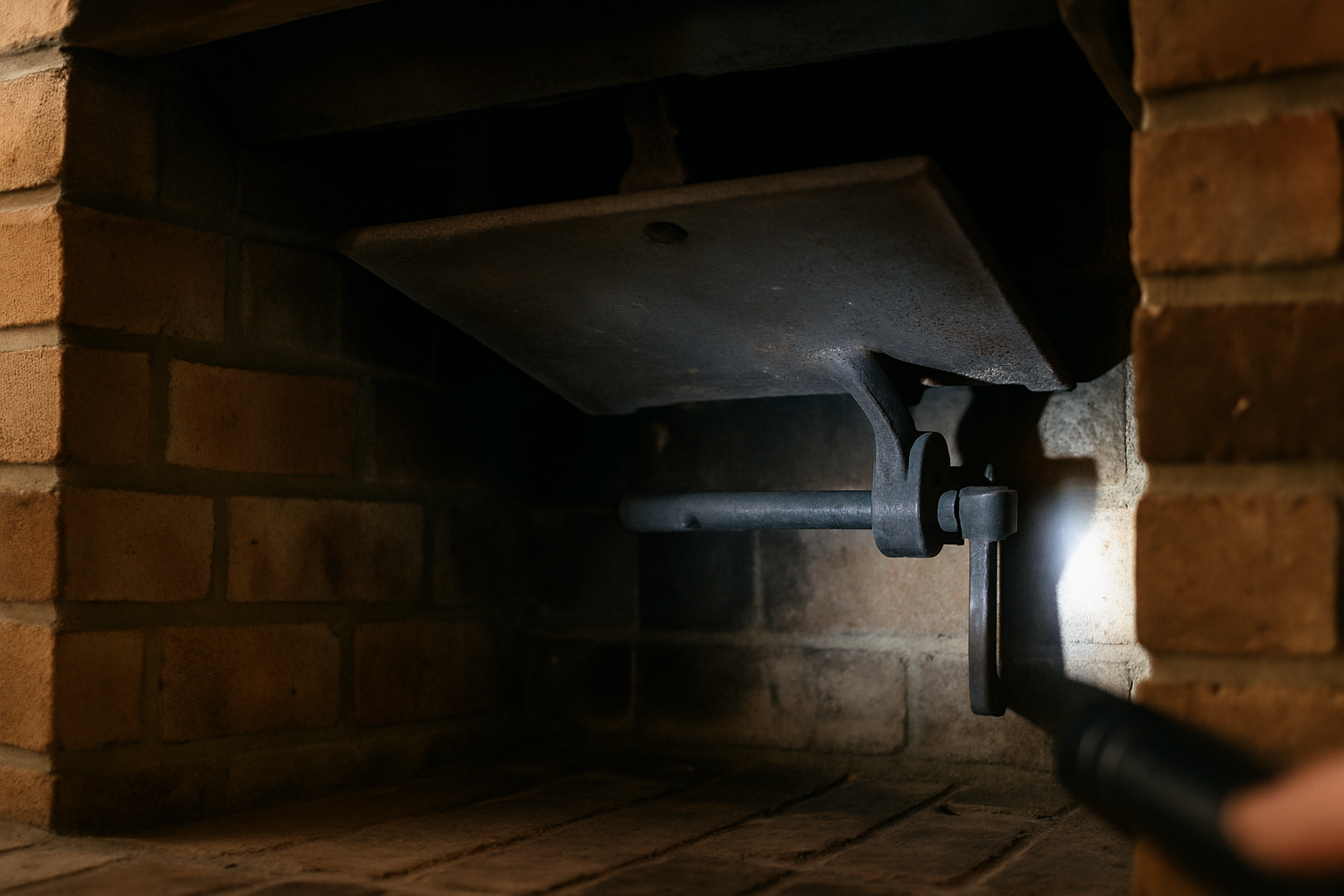
Damper Repair and Replacement, Houston, TX
A failed chimney damper doesn't get a default replacement quote. It gets a diagnosis first. Our team tests plate movement, hinge resistance, frame seating, and closure gap before recommending a single thing, then delivers that finding in writing.
Call (832) 662-3437Damper Repair and Replacement, Houston, TX
Seized hinge, visible closure gap
A left-side hinge completely seized from corrosion, with a quarter-inch opening visible even in the closed position.
Flush seat, full range of motion
Both hinges freed, corrosion removed, high-temp lubricant applied, and cycled twenty times to confirm the plate seats flush across the full frame edge.
Get Your Chimney Damper Working Correctly Before Houston Humidity Corrodes It Further
Houston's summer humidity is the primary enemy of cast-iron throat dampers.
Here's what most homeowners don't realize about Houston dampers: the problem rarely develops during the burning season. It develops during the summer, when the flue sits dormant in high humidity. Cast-iron is porous at the hinge points and along the frame edges. When humid outdoor air sits in contact with those surfaces for five or six months, iron oxide, rust, accumulates at the pivot points where the damper plate rotates. That's what damper hinge corrosion looks like in practice. Understanding how Houston humidity accelerates chimney corrosion explains why dormant-season damage is so consistent across the metro.
A damper that opened freely last November may bind by October. The mechanism isn't dramatic. It's gradual. But the result is either a plate that won't open fully, restricting airflow and causing smoke to back up into the firebox from the first moment a fire is lit, or a plate that won't seat properly when closed. That second condition creates a damper sealing gap, the space between a closed plate and its frame, wide enough for warm outdoor air, insects, and humidity to enter the living space through a "closed" fireplace all summer long.
832 Home Service has diagnosed and repaired chimney dampers across the Houston metro since 2010. The pattern of seasonal hinge corrosion is well understood here.
A service scenario from a 832 Home Service call in Humble, TX, described by our field lead.
Damper Operation Tested and Repair or Replacement Completed in a Single Visit
The call came from a home in Humble, post-1990 construction, original throat damper, never serviced specifically for the damper. The homeowner said it wouldn't open all the way and they'd been managing it for two seasons. Lighting fires with the damper partially open explained why the smoke shelf was in poor condition.
The damper operation test came first: opened and closed the plate by hand, checked hinge resistance on both pivot points, examined how the plate seated against the frame. The hinge on the left side was completely seized from corrosion. The right side was binding but still moving. The plate itself was in good shape, flat, no warping from thermal cycling. The damper frame was intact and properly positioned.
That combination points to something specific. The plate wasn't a warped damper casting. A warped damper casting is a plate distorted by repeated high-heat cycles, when you close it, a gap runs across the full frame because the plate can't conform to the seat anymore. This plate was flat. The problem was entirely at the hinge points.
Repair was the right call. Both hinges were freed, corrosion was removed from the pivot points, and high-temperature lubricant rated for flue conditions was applied. The plate was run through twenty full open-close cycles to confirm full range of motion and correct seating. The homeowner watched the process. The damper sealing gap was measured before and after, before, a quarter-inch opening was visible on the left side even with the handle in the closed position. After, the plate seated flush across the full frame edge.
That's the outcome repair is supposed to produce. Replacement isn't the recommendation when repair achieves that result.
Spring, Humble, and Kingwood are exactly the communities where this scenario is routine. Post-1985 residential construction means original throat dampers now 35 to 40 years old, the age range where humidity-driven hinge corrosion and frame distortion become predictable service needs.
A Corroded Damper Frame Changes the Recommendation, Here's How We Handle That
When the frame is the problem, repair cannot produce a reliable seal, and we say so plainly.
Some Houston homeowners ask whether lubrication alone can fix a damper that's not sealing. Sometimes, yes. The distinction comes down to the frame.
A damper with corroded hinge points can be restored to full function when the damper frame is still structurally intact. The plate has a correct surface to seat against. Freeing the pivot and applying lubricant produces a real result.
A damper with a corroded or distorted frame is a different situation. If the frame has rusted along its seating edge, or if thermal cycling has bent the housing out of its original profile, the plate has no correct surface to seat against. The hinge can be freed and the plate can still show a visible damper sealing gap at closure because the geometry is wrong. Lubricating a failed frame doesn't correct the geometry.
In those cases, replacement is the correct path. That may mean a like-for-like throat damper replacement, or it may mean a top-mount damper replacement, the substitution of a top-sealing damper installation in Houston at the crown level. A top-mount replacement is appropriate when the throat frame is corroded beyond repair and a permanent solution is preferred over another cast-iron throat unit in the same environment. This option seals at the top of the flue column, removing the humid-air infiltration path through an open flue entirely.
We explain which condition you have. In writing.
Our Standards for Chimney Damper Repair and Replacement
Every damper service at 832 Home Service follows a documented, component-specific assessment protocol.
- ✓Damper operation test completed before any work recommendation is made; we begin with a thorough routine chimney inspection before damper work to confirm damper findings in full system context
- ✓Throat damper plate condition assessed separately from damper frame condition
- ✓Hinge corrosion severity graded on a three-point scale: freeable, marginal, or seized-through
- ✓Warped damper casting identified by direct measurement of the closure gap across the full frame seat, not by visual estimate alone
- ✓Repair materials limited to high-temperature-rated components specified for flue conditions; all service standards are benchmarked against CSIA homeowner chimney maintenance standards
- ✓Top-mount damper replacement option presented when throat frame condition makes like-for-like replacement inadvisable
- ✓Written findings delivered after assessment, before any work begins
- ✓Post-service damper operation test performed and documented, plate cycled a minimum of twenty times to confirm full range of motion and correct seating
No repair recommendation is made without a completed damper operation test. No replacement recommendation is made without a confirmed finding of frame distortion or casting warpage that repair cannot address.
How We Diagnose, Repair, or Replace Your Chimney Damper
The service follows a fixed three-phase sequence, diagnosis, implementation, confirmation.
Phase 1: Diagnostic Assessment
The damper operation test begins first. The plate is moved through its full range of motion by hand. Hinge resistance is checked on both pivot points. Frame seating is inspected along the full perimeter. The closure gap is measured at multiple points around the frame seat.
Three specific findings determine the path forward: Is the plate flat, or does it show warpage from thermal cycling? Are the hinge points corroded, and to what degree? Is the frame seated correctly in the firebox throat, and is its seating edge intact?
Each finding is documented before implementation begins. During this phase we also inspect the smoke chamber repair and related components above the damper to identify any related conditions that could affect draft performance after the damper service is complete.
Phase 2: Implementation
For damper repair: hinge points are freed mechanically. Iron oxide accumulation is removed from the pivot surfaces. High-temperature lubricant is applied and worked into the pivot through repeated cycling.
For like-for-like throat damper replacement: the failed unit is removed in full. The throat opening is measured before any replacement unit is specified. The new plate and frame are installed and positioned to the throat geometry.
For top-mount damper replacement: the unit is installed at the crown level. The cable control system is routed down through the flue to a handle mounted inside the firebox. This approach seals at the top of the flue column rather than at the throat, eliminating the humid-air infiltration path through an open flue column entirely.
Phase 3: Post-Service Confirmation
After any repair or replacement, the damper operation test is repeated. The plate is cycled twenty times minimum. Seating is checked at the full frame perimeter. The closure gap is measured and compared to the pre-service measurement. Findings from both the pre- and post-service test are included in the written documentation delivered to the homeowner.
Areas We Serve
832 Home Service performs chimney damper repair and replacement across the Greater Houston area.
Our crews serve Houston, Spring, Humble, Kingwood, Katy, Sugar Land, The Woodlands, Pearland, Friendswood, Pasadena, Baytown, Deer Park, La Porte, League City, Galveston, Texas City, Beaumont, Conroe, Tomball, Cypress, and all surrounding communities. We dispatch from our Houston location at 2 Mockingbird Cir, Houston, TX 77074.
Damper Condition Assessed, Repair or Replace Recommendation With Written Explanation
A failed chimney damper in Houston gets a diagnosis first, not a default replacement quote.
The throat damper plate, the flat cast-iron or steel plate inside the firebox throat that rotates on a hinge to open and close the flue, is one of the most humidity-exposed mechanical components in any Houston home. When it stops working correctly, the cause matters. A stuck hinge is a different problem than a warped casting. A displaced plate is different from a corroded damper frame, the cast-iron housing in which the plate sits and pivots.
832 Home Service performs a full damper operation test, a physical check of plate movement, hinge resistance, frame seating, and closure gap, before making any recommendation. If the hinge is corroded but the frame is intact, repair is the right answer. If the casting has warped from years of thermal cycling, replacement is the only way to get a reliable seal. You receive a written explanation of which condition is present and why the recommendation follows from it.
Warped casting means replacement. Stuck hinge means repair. We tell you which one you have and why.
Frequently Asked Questions
How do you decide whether my damper needs repair or replacement?
We complete a full damper operation test first, checking plate movement, hinge resistance, frame seating, and the closure gap. If the hinge is corroded but the frame is intact, repair is the right answer. If the casting is warped or the frame is distorted, replacement is required for a reliable seal. You get that finding in writing before any work begins.
Why does my damper stick even though I only use my fireplace in winter?
In Houston, the damage usually happens during the dormant summer season. Humid air sitting against porous cast-iron hinge points builds iron oxide over five or six months, so a damper that opened freely last November may bind by October.
Can lubrication alone fix a damper that won't seal?
Sometimes, yes, when the frame is still structurally intact and the plate has a correct surface to seat against. But if the frame has rusted along its seating edge or bent from thermal cycling, lubrication won't correct the geometry, and replacement is the correct path.
What is a top-mount damper replacement?
A top-mount, or top-sealing, damper installs at the crown level with a cable control routed down to a handle inside the firebox. It seals at the top of the flue column, removing the humid-air infiltration path entirely, and is ideal when a throat frame is corroded beyond repair.
Can the damper be fixed in a single visit?
In most cases, yes. Diagnosis, repair or replacement, and post-service confirmation, including cycling the plate a minimum of twenty times, are completed in one visit, with written findings delivered to you.
Ready to Get Your Damper Working Correctly?
Describe the symptom and we'll explain what the assessment involves.
If your damper is stuck open, won't close fully, or lets outdoor air through a "closed" fireplace, a damper operation test is the first step. Call 832 Home Service at (832) 662-3437 or email in**@****************es.com. You can also reach us at 832chimneyservices.com. We'll schedule the assessment and deliver written findings before any work begins. If your chimney needs attention beyond the damper itself, ask about our full chimney repair when damage extends beyond the damper.
Contact our team today for a free consultation.