
Chimney swifts are federally protected in Houston from May through October. Know your legal options, the departure timeline, and when to schedule cap installation.
Chimney swifts are protected by federal law during every day they spend in Houston, full stop.
Chimney swifts (Chaetura pelagica) – small, torpedo-shaped migratory birds that nest almost exclusively inside vertical cylindrical structures like masonry chimneys – travel through Houston on the Central Flyway each year. The Central Flyway is one of four major north-south migratory corridors in North America, running directly through the Houston metro area. Harris County sits near the heart of it.
The Migratory Bird Treaty Act of 1918 (MBTA) makes it a federal offense to take, kill, capture, possess, or disturb any chimney swift, its nest, its eggs, or its young. That protection does not pause because the timing is inconvenient. It does not expire because you have a contractor scheduled. It applies regardless of whether you knew the birds were protected before they arrived.
Here’s what most homeowners don’t realize: the law covers not just the birds themselves, but the active nest inside the chimney. A cup-shaped nest of pine needles and saliva glued to your flue wall is a federally protected structure while eggs or young are present. This page covers the full Houston-specific seasonal timeline, what you legally can and cannot do in each phase, and what the permanent solution looks like once the birds have departed on their own.
Houston’s position on the Central Flyway makes it one of the highest-traffic chimney swift zones in the country.
832 Home Service fields chimney swift calls from homeowners across the Greater Houston area each spring with the highest call volume coming from established neighborhoods in West Houston and the Inner Loop. Older homes in these areas often have uncapped masonry chimneys built in the mid-20th century, well before chimney caps became standard practice. Those open chimneys sit directly beneath the tree canopy that chimney swifts use as a visual navigation landmark during their Central Flyway transit through Harris County.
There’s an additional factor specific to Houston’s geography. The city’s proximity to the Gulf of Mexico compresses the migration window. Swifts flying north from their South American wintering grounds often arrive in Houston before continuing further north, using the area as a staging location. That means Houston chimneys see both transiting birds and resident nesters within the same spring arrival period. The distinction matters, because a staging roost chimney and an active nesting chimney have different protected windows – and different timelines for when cap installation can proceed.
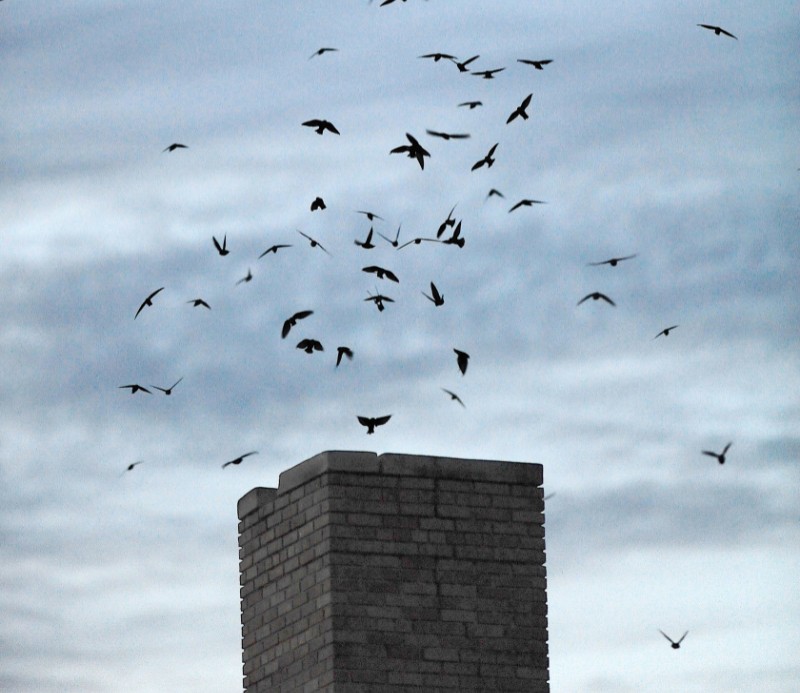
The chimney swift presence cycle in Houston runs roughly seven months, but your legal situation changes at each phase.
Understanding which phase you’re currently in determines every option available to you. Here is the full timeline for the Houston area, based on Harris County latitude and Gulf Coast climate conditions.
Chimney swifts typically arrive in the Greater Houston area between late March and mid-April. During this early phase, birds may use a chimney as a communal roost, a nighttime gathering place where dozens or hundreds of swifts spiral in together at dusk. No nesting is occurring yet. The birds are resting during migration or establishing territory.
What you can do: Nothing involving the chimney interior. The birds and any location they occupy are protected under the MBTA from the moment of their arrival. Blocking entry or disturbing the roost is not permitted.
What you can observe: The classic “swift tornado”, a visible, spiraling column of birds descending into the chimney at dusk, is one of the more remarkable wildlife events in urban Houston. It requires no intervention.
This is the fully protected period. A mated pair selects a chimney, constructs a small bracket-shaped nest of sticks and saliva on the interior flue wall, and raises a clutch of four to five eggs. Incubation lasts roughly 19 days. Young swifts remain in the nest for approximately 28 to 30 days before fledging. The nesting season in Houston typically runs from late May through mid-August, though the exact window varies slightly year to year based on temperature and arrival timing.
What you can do: Nothing that disturbs the nest, eggs, young, or parent birds. The MBTA is explicit. No contractor, including 832 Home Service, will perform interior chimney work during confirmed active nesting. This is not a business policy. It is federal law.
What you cannot do: Remove the nest, block the chimney opening, apply any chemical deterrent, or disturb the chimney interior in any way while nesting is active.
A note on permits: homeowners sometimes ask whether a federal permit can be obtained to authorize removal during nesting season. The U.S. Fish and Wildlife Service does issue special use permits under the MBTA, but not for the purpose of clearing a chimney for personal convenience. Those permits are issued for scientific research, education, and certain wildlife management programs. A private homeowner cannot obtain one to resolve a scheduling conflict.
After young swifts fledge, typically by late August in the Houston area, the family group joins other swifts gathering for southbound migration. Activity in your chimney will decrease noticeably. By mid-September, most nesting-season residents have departed the immediate area.
This phase opens a planning window for cap installation. However, fall migration transit (Phase 4) means swifts may still be moving through Houston, and roost use of the chimney can continue into October.
What you can do: Begin planning. Contact 832 Home Service to schedule a post-departure inspection and cap installation estimate for the November window.
Chimney swifts traveling south from their northern breeding grounds pass through Houston during October. A chimney that hosted a nesting pair in summer may temporarily host transient roost birds again during fall migration. This activity ends by late October to early November at Harris County latitudes.
After confirmed departure, typically by the first two weeks of November, cap installation can proceed without any risk of disturbing active nesting or roosting birds.
What you can do: Once you confirm birds are no longer present, contact 832 Home Service to schedule stainless steel chimney cap installation. This is the permanent exclusion solution.
832 Home Service, Houston TX (serving Greater Houston since 2010)
Post-season chimney cap installation is the only permanent solution to recurring chimney swift access.
Once Houston’s chimney swifts have departed confirmed by late October or early November a stainless steel chimney cap with appropriately sized mesh can be installed over every open flue on your chimney. The mesh openings are sized to exclude birds while maintaining proper draft for fireplace or heating appliance use. This is not a seasonal patch. A properly installed cap eliminates swift access on a permanent basis without harming birds, without violating federal law, and without repeating this situation the following spring.
Before scheduling cap installation, 832 Home Service confirms departure with a visual inspection. We do not install caps on chimneys with active roosting or nesting present that would constitute a disturbance under the MBTA. The inspection step is non-negotiable, and it protects you as much as it protects the birds.
If you’re reading this in the off-season, November through March is the ideal installation window for Houston chimneys. No delays, no legal constraints, no seasonal conflict.
Your legal options in any given week depend entirely on which phase the Houston swift season is in. The practical plan for most Houston homeowners: a post-season inspection in November, cap installation at the same appointment, and no further chimney swift access ever without any legal complication or repeated seasonal disruption.
Here’s a plain summary by timing:
And you hear or see swifts in your chimney: document the activity, note whether you're observing communal roosting (many birds) or a quieter nesting situation (a pair), and call 832 Home Service. We will confirm nesting status and give you an accurate departure timeline. No work proceeds during the protected window.
This is the open window. Swifts have departed Houston by early November and do not return until late March at the earliest. Chimney cap installation can be performed on any chimney with confirmed absence during this period.
832 Home Service serves chimney swift assessment and cap installation calls across the Greater Houston area.
Contact our team today for a free consultation. Call 832 Home Service at (832) 662-3437 or email info@832chimneyservices.com
The right first step is a call, not a contractor visit, so we can confirm your phase and legal situation.
If you currently have swifts in your chimney, call 832 Home Service at (832) 662 3437 before taking any action. We’ll confirm whether you’re in the nesting window, give you an accurate departure timeline, and put a post season cap installation plan in place so this doesn’t repeat next spring.
WhatsApp us
Tell us what’s going on and we’ll get back to you, often the same day.
Prefer to talk? (832) 662-3437