Flue Measured On-Site and Correctly Sized Replacement Cap Installed Same Visit. When a cap comes off, the clock starts. We measure the flue termination on-site, match the right material to your location, and install a properly seated replacement the same visit. No guesswork, no nearest-available-size substitution.
Houston’s severe thunderstorm corridor puts chimney caps at risk every spring and fall. The Harris County storm track, running from Katy and Sugar Land in the west through Baytown and Pasadena in the east, produces wind events that lift loosely fitted or corrosion-fastened caps clean off the chimney top. National Weather Service Houston storm track data confirms the frequency and severity of storm systems moving through this corridor.
Here’s what most homeowners don’t realize about Houston cap failures: it’s rarely the wind alone. Cap fastener corrosion, the slow deterioration of the screws, rivets, or clips holding the cap to the flue liner or crown, weakens the connection over years of exposure to Houston’s coastal humidity. Understanding how Houston’s coastal humidity accelerates chimney corrosion explains why so many caps that appear intact from the ground are already structurally compromised at the fasteners. By the time a named storm or a fast-moving thunderstorm line passes through, many caps are being held by corroded hardware that’s a fraction of its original strength. The wind gets the credit. The humidity did most of the work first.
After a major storm event, 832 Home Service regularly receives cap replacement calls from multiple neighborhoods simultaneously, the same system that displaced a cap in Pearland displaced caps in League City and Webster within the same hour.
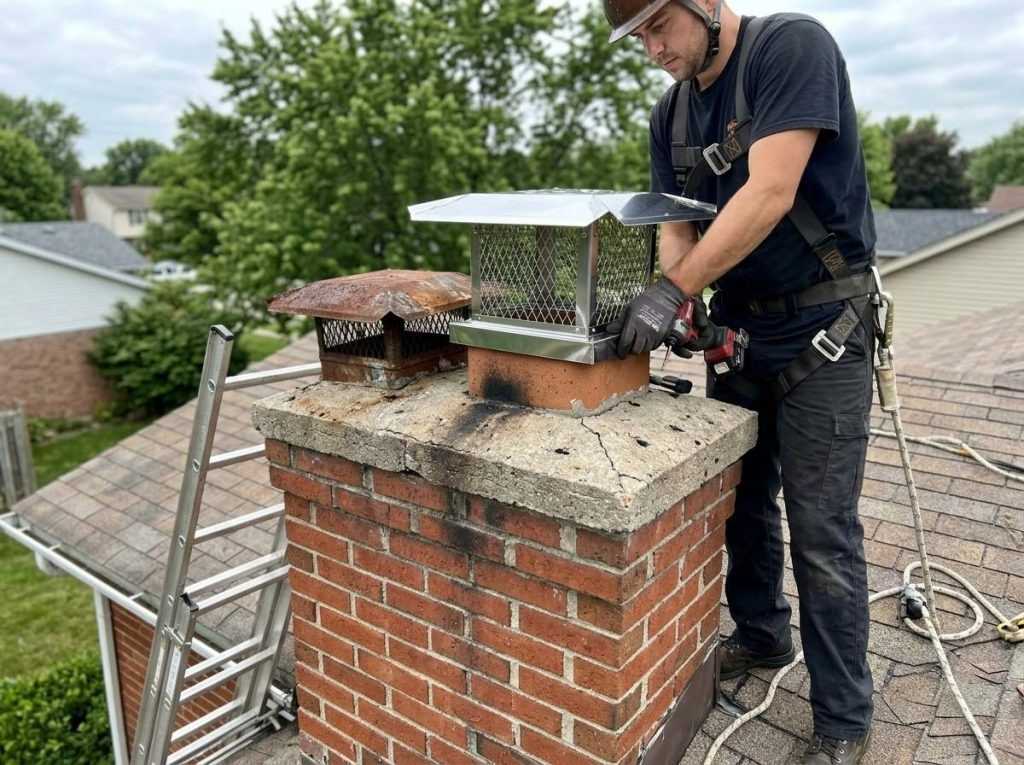
When storm damage extends beyond the cap itself, we also provide emergency storm damage repair for chimneys to address the full scope of what a major weather event can do to a chimney system. Any time a cap is displaced and the flue is left open, the risk of water intrusion is immediate, which is why we also handle chimney leak repair after storm damage when the exposed flue period has allowed moisture to enter.
The cap was on the roof deck, not in the yard, which told me something important right away.
I’m one of the field techs at 832 Home Service, and I’ve been replacing storm-displaced caps in the south Houston area since about 2013. When a cap lands on the roof nearby instead of falling into the yard, it usually means the wind lifted it straight up. That kind of lift, without a horizontal throw, almost always points to a mounting failure, not just wind speed.
On this Friendswood call, the homeowner had a galvanized steel cap that looked fine from the ground. When I got up and looked at the flue liner termination, the screws had rusted to near nothing. The cap was sitting on the liner tile with about a quarter inch of overlap. One good gust was always going to take it. The original cap was also undersized by about a half inch on each side, meaning it was never seated properly to begin with. Proper cap sizing and seating follows Chimney Safety Institute of America standards, and this installation had fallen short of those requirements from day one. In cases like this, we also check the crown surface carefully, chimney crown damage affecting cap seating is a common underlying issue when a cap has never fit correctly or when the mounting surface has deteriorated over time.
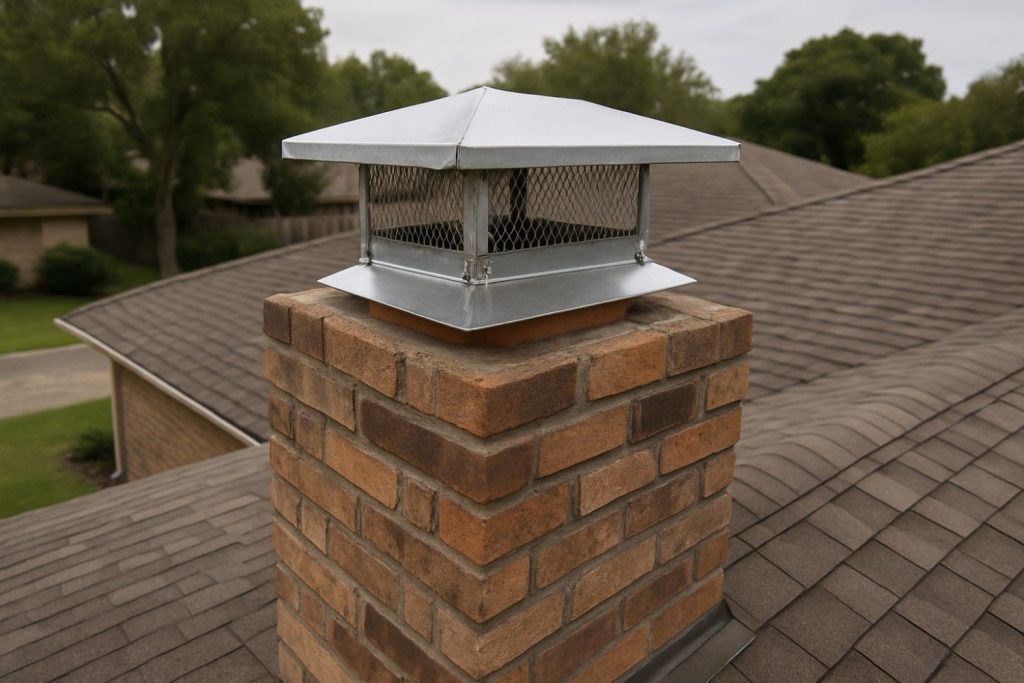
We measured the flue termination opening before touching anything else: 13 inches by 13 inches on the liner tile interior. The correct replacement required a cap with a base frame that sat over the tile exterior with a proper overlap margin. A stock cap in the wrong size would have done the same thing the old one did.
We installed a stainless steel replacement with band-clamp seating, the cap seating method that has the highest wind resistance for that flue configuration. That cap isn’t going anywhere in the next storm.
We access the chimney top and confirm three things: where the old cap is or was, whether the crown and liner termination are intact, and what caused the cap to fail. A storm-displaced chimney cap and a cap that failed from fastener corrosion alone require the same replacement, but the crown inspection findings can differ significantly. A post-storm chimney assessment at this point confirms whether other components were affected in the same event. The flue termination measurement is taken here. Interior liner tile dimension, termination height above the crown, and crown surface condition are all recorded.
The replacement cap specification is built from the measurement, not from available stock. Flue interior dimension determines the base frame size. Location and exposure determine the material: stainless steel is the standard for Houston's climate; copper is available for custom applications. The cap seating method is selected based on the chimney top configuration and the wind resistance required. Installation includes mounting hardware appropriate for the seating method. Band-clamp installations are torqued to manufacturer spec. Screw-down installations use stainless fasteners, not galvanized screws that corrode out in Houston's humidity.
Once the replacement cap is seated, we verify the fit visually and by hand, checking for secure contact at every mounting point. Any cap that moves under manual load is corrected before the crew leaves. The exposed flue period, the window between the original cap's failure and the replacement, ends at this point. Findings from the service call are documented and shared with the homeowner.
A replacement cap is not the same as a new installation, it’s a correction. The original cap failed for a reason. Before a replacement goes on, that reason matters.
832 Home Service replaces chimney caps across Houston by measuring the flue termination on-site, confirming the correct cap dimensions, selecting the right material for the location, and installing a properly seated unit the same visit. No guesswork. No nearest-available-size substitution.
This page is for Houston homeowners who’ve already lost a cap, to a storm, to rust, or to a fastener that finally gave out. If you’re starting from scratch rather than replacing a failed unit, see our page on professional chimney cap installation in Houston.
Every chimney cap replacement at 832 Home Service starts with a flue termination measurement. That’s not complicated, but it’s the step that gets skipped when a cap is pulled from stock and assumed to fit.
Here’s why the measurement matters. A replacement cap that is slightly too large sits loosely over the flue liner tile. During the next wind event, it lifts off again. A cap that is slightly too small leaves a gap at the base where rain enters and animals can squeeze through. Neither result is a successful replacement.
We take the measurement at the time of the service call. The replacement cap is selected based on that measurement, interior flue dimension, liner termination configuration, and the correct seating method for the chimney top. That’s the complete replacement cap specification process, done before anything is installed.
Every chimney cap replacement 832 Home Service installs meets a consistent set of requirements. Here’s what that looks like in practice:
Interior dimension confirmed before any replacement is selected.
Friction fit, screw-down to crown, or band-clamp around liner termination, each has a different wind load profile. Houston's storm history informs that selection.
A storm that displaces a cap often affects the crown, flashing, and mortar joints simultaneously. We note any additional findings before leaving.
Galvanized steel in high-humidity coastal areas corrodes faster. Stainless steel or copper is specified where the environment justifies it.
If the existing crown or liner termination shows deterioration at the mounting surface, that's documented before installation.
A replacement is a correction. The original cap failed for a reason, so before we install a new one, we confirm what caused the failure, whether that’s storm displacement, fastener corrosion, or an undersized cap that was never seated properly to begin with.
A cap that’s slightly too large lifts off in the next wind event. A cap that’s slightly too small leaves a gap where rain enters and animals squeeze through. We measure the interior flue dimension, liner termination configuration, and seating method on-site so the replacement fits the flue you actually have.
Yes. We measure on-site, select the correct replacement, and install a properly seated unit the same visit. Ending the exposed flue period quickly matters in Houston’s climate, where an open flue rarely stays dry for long.
Houston’s coastal humidity accelerates corrosion at the cap fasteners, the screws, rivets, or clips holding the cap in place. That’s why we specify stainless steel as the standard for our climate and use stainless fasteners rather than galvanized screws that corrode out.
Often, yes. The same event that displaces a cap can affect the crown, flashing, and mortar joints. We offer a post-storm chimney assessment during the replacement and can handle emergency storm damage repair and chimney leak repair if moisture entered during the exposed flue period.
(832) 662-3437
832 Home Service replaces chimney caps in communities across the full Houston metro. The full Harris County storm track, east to west, is within our service footprint.
An open flue in Houston doesn’t stay dry for long.
Call 832 Home Service at (832) 662-3437 or email info@832chimneyservices.com to schedule your Chimney Cap Replacement.
WhatsApp us
Tell us what’s going on and we’ll get back to you, often the same day.
Prefer to talk? (832) 662-3437