Chase Cover Opening Measured Before Any Repair or Replacement Material Is Sourced. Chase Cover Opening Measured Before Any Repair or Replacement Material Is Sourced.
A chimney chase cover repair addresses rust-through, seam separation, or a cover that never fit correctly, stopping water from reaching the wood-framed chase enclosure below.
Galvanized steel corrodes from the underside first. That’s the side facing down into the chase, where salt air and humidity collect and where no one looks during a routine walk-around. By the time rust stains appear on the chase siding, or water damage inside the chase enclosure, the cover has been failing for years. The first thing most Houston homeowners notice isn’t the cover at all. It’s a water stain on the ceiling near the fireplace. The chimney chase cover, the flat or sloped metal panel that caps the top of the chase enclosure, is where the water actually entered.
Here’s what most homeowners don’t realize about prefab chimney systems: the chase enclosure is a wood-framed structure. It looks like masonry from the street. But underneath the siding, it’s dimensional lumber and sheathing, materials that absorb moisture, swell, and eventually rot when a failed cover lets water in repeatedly. The stakes for a deteriorated cover are higher than they appear from ground level.
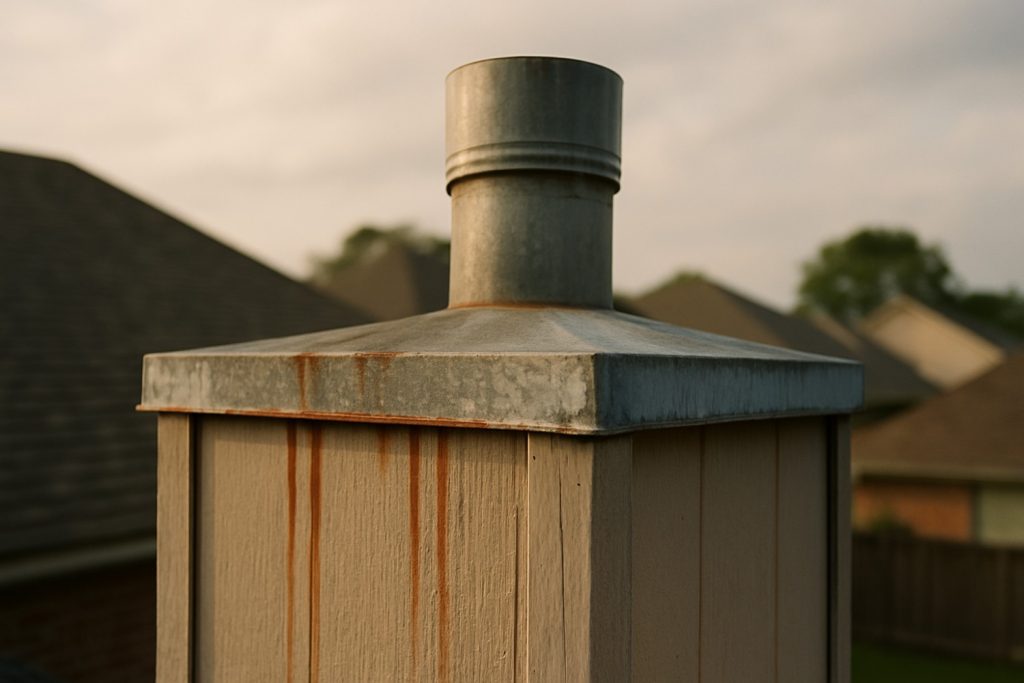
Most Houston chase covers installed during the city’s 1990s suburban build-out were galvanized steel, and that material has a predictable failure timeline in Gulf Coast air.
832 Home Service repairs chimney chase covers throughout Houston’s northwest suburban communities, including Cypress, Tomball, and Jersey Village, where post-1990 tract construction used galvanized steel chase covers (zinc-coated steel, the standard builder-grade material of that era) that are now showing corrosion consistent with 30 or more years of Gulf Coast humidity exposure.
Gulf Coast salt air doesn’t just come off the water in Galveston. It moves inland. Cypress and Tomball sit far enough from the bay that most homeowners don’t think of themselves as living in a salt-air environment. But sustained humidity at this level corrodes unprotected steel at rates that catch people off-guard. Learn more about how Gulf Coast humidity accelerates metal corrosion in our Houston climate resource.
We’ve been repairing and replacing chase covers across the Houston metro since 2010. The northwest suburban stock is now deep into the window where galvanized covers fail. We see it consistently.
Rust-through, seam separation, and improper fit are each distinct problems, and each one has a different repair approach. Understanding which failure mode is present changes what we do next. That’s why every repair assessment at 832 Home Service starts with measuring the chase opening. We confirm whether the existing cover can be repaired or whether the opening dimensions require a correctly sized replacement. That step happens before any material is sourced.
The condition where corrosion has consumed enough of the cover's thickness that water passes directly through the metal panel. This isn't a seam problem or a fit problem. The panel itself has failed. Replacement with a correctly sized, corrosion-resistant cover is the right call. For homeowners weighing long-term options, our stainless steel chase cover installation service covers what's involved in a full replacement versus a targeted repair.
Happens when a welded or folded joint opens. Hail impact is a common cause in Houston, where spring and fall storm seasons regularly produce hail large enough to deform sheet metal. Thermal cycling, the daily expansion and contraction of a metal panel in Houston's temperature swings, does it over time without any single event. Some seam separations can be re-sealed. Others indicate the cover has deformed enough that replacement is the cleaner solution.
The quiet one. A cover that was never correctly sized, or one replaced with a universal-fit panel that doesn't match the opening dimensions, leaves a gap at the edge. Wind-driven rain in Houston doesn't need much of an opening. The fix here is dimensional verification and correct sizing, not patching the gap.
The call came in because of a ceiling stain, not because anyone suspected the chase cover.
A family in Cypress noticed a water stain on the ceiling in the room adjacent to their prefab fireplace. They called a roofer first. The roofer went up, didn’t find obvious roof damage, and suggested the issue might be chimney-related.
When we arrived, I went straight to the chase top. The galvanized cover was sitting in place and looked intact from below the roofline. But when I got up to it, the underside told a different story. The coating had failed along the center seam, that’s cover seam separation, where a folded or welded joint opens from thermal expansion cycling over years, and the base layer of steel had corroded through in two spots near the back corner. Both failure modes were present at once.
The cover was a 1990s original. It measured 16 inches by 24 inches at the opening, but a replacement the homeowner had purchased at a home improvement store measured 14 by 22. Loose covers create gaps at the edge. Gaps let water in just as reliably as rust-through does. That’s chase cover dimensional fit: the match between the actual opening and whatever panel sits on it. A cover that’s too small is a cover that fails.
We sourced a correctly dimensioned stainless steel replacement, confirmed the fit before finalizing anything, and had it installed that afternoon. The ceiling stain never came back.
— Field account from the 832 Home Service team, Cypress service call
The variables that shape a chase cover repair are the failure mode, the opening dimensions, and how long water has been entering the chase enclosure.
The first variable. Rust-through means replacement. A single seam separation on an otherwise sound cover may mean a targeted repair. An improperly sized cover means the measurement step determines everything that follows.
Affect both cost and timeline. Standard sizes can often be sourced and installed same-day. Non-standard openings, common in custom-built homes in The Woodlands or older properties in Pasadena with modified chase structures, may require fabrication. We confirm the dimensions before quoting so there are no surprises.
Affect both cost and timeline. Standard sizes can often be sourced and installed same-day. Non-standard openings, common in custom-built homes in The Woodlands or older properties in Pasadena with modified chase structures, may require fabrication. We confirm the dimensions before quoting so there are no surprises.
Matters because the chase enclosure is wood-framed. A cover that failed recently may mean only the cover needs attention. A cover that has been leaking for multiple Houston rainy seasons may mean the framing, sheathing, or liner inside the enclosure has absorbed enough moisture to require additional work. We assess the enclosure interior as part of the repair visit, not as a separate add-on. Once the chase cover is addressed, we also evaluate chimney flashing repair for related leak sources that can allow moisture to continue entering even after the cover itself is repaired.
Every chase cover assessment begins with a dimensional measurement of the chase opening, not an assumption about standard sizingChase covers are not universal fit. A cover that looks close enough from the ground may undermine the repair before it starts. Here’s what our process covers: Where the existing cover can be repaired, sealed seams, re-secured edges, we do that. Where the cover has failed past the point of repair, we source the correct size and install it the same visit when material is available.
length, width, and edge profile measured before any replacement is specified
rust-through, seam separation, or fit problem documented separately
Stainless steel selected for properties within 20 miles of the Gulf Coast; galvanized is not specified as a replacement material for Houston's coastal air environment
corrosion depth on the existing cover checked where accessible
Framing, liner, and surrounding combustibles inspected for moisture exposure from the failed cover. Review the Chimney Safety Institute of America standards to understand why deteriorated covers pose serious structural risks to wood-framed enclosures
Replacement cover seated and checked before the job is called complete
The chimney chase cover is the flat or sloped metal panel that caps the top of the chase enclosure. It fails through rust-through, seam separation, or improper fit. Galvanized steel corrodes from the underside first, where salt air and humidity collect, so by the time rust stains appear on the chase siding the cover has been failing for years.
Chase covers are not universal fit. A cover that’s too small leaves a gap at the edge, and wind-driven rain in Houston doesn’t need much of an opening. We confirm length, width, and edge profile before any replacement is specified, so a cover that doesn’t fit correctly doesn’t become a cover that fails again.
Stainless steel is the correct long-term choice for Houston’s Gulf Coast air environment. We specify stainless for properties within 20 miles of the Gulf Coast; galvanized is not specified as a replacement material for Houston’s coastal air. Stainless costs more at installation but does not corrode from the underside on the same timeline.
Yes. The chase enclosure is a wood-framed structure. A cover that has been leaking for multiple Houston rainy seasons may mean the framing, sheathing, or liner inside the enclosure has absorbed enough moisture to require additional work. We assess the enclosure interior as part of the repair visit, not as a separate add-on.
Yes. The chase enclosure is a wood-framed structure. A cover that has been leaking for multiple Houston rainy seasons may mean the framing, sheathing, or liner inside the enclosure has absorbed enough moisture to require additional work. We assess the enclosure interior as part of the repair visit, not as a separate add-on.
(832) 662-3437
832 Home Service repairs chimney chase covers throughout the Greater Houston area and surrounding communities.
832 Home Service measures every chase opening before sourcing a replacement, because a cover that doesn’t fit correctly is a cover that fails again.
Call 832 Home Service at (832) 662-3437 or email info@832chimneyservices.com to schedule your Chimney Leak Repair assessment.
WhatsApp us
Tell us what’s going on and we’ll get back to you, often the same day.
Prefer to talk? (832) 662-3437