Chimney Exterior Restoration in Houston, TX
Houston, TX
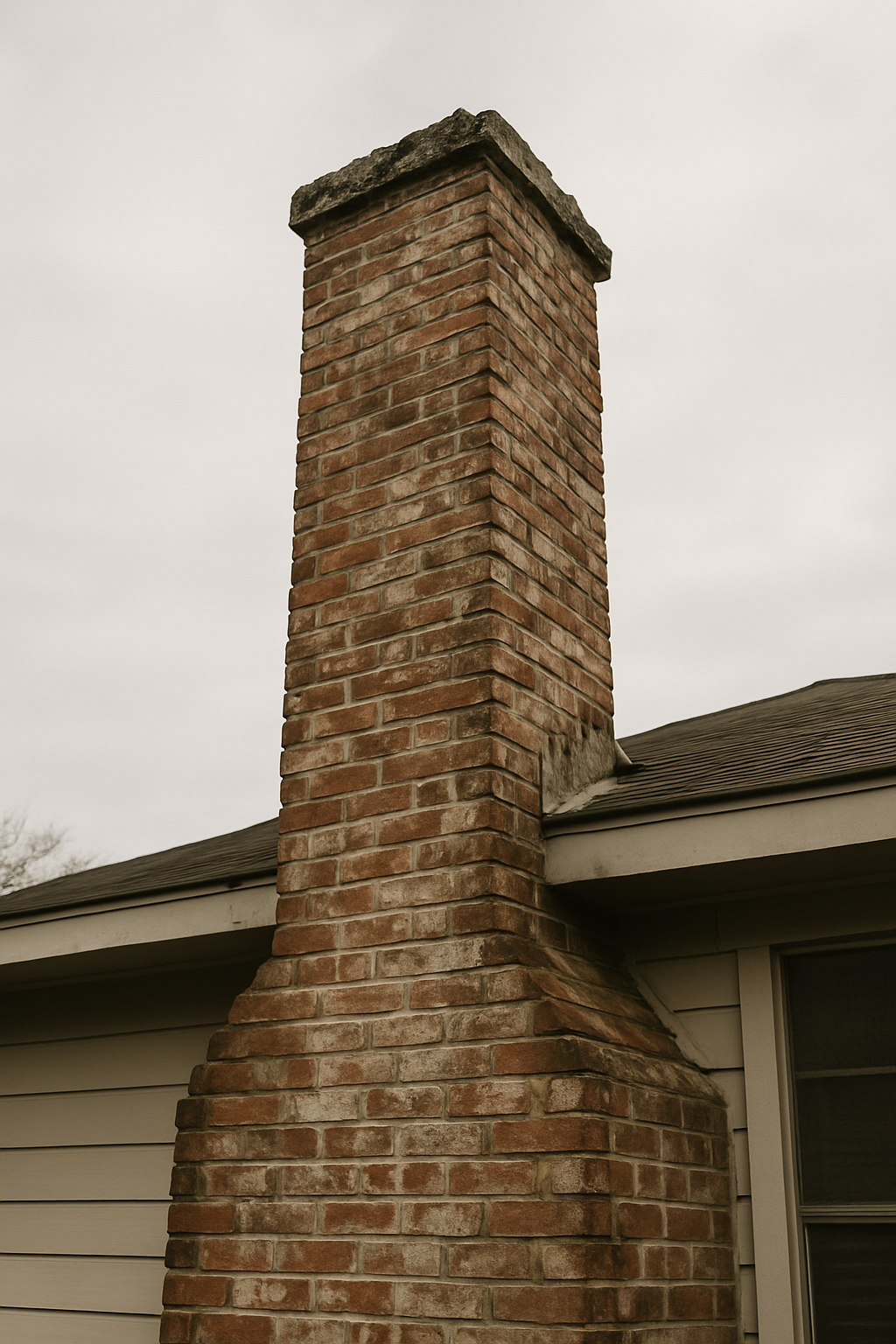
Chimney Exterior Restoration in Houston, TX
When the crown, mortar joints, brick faces, and surface coating all fail together, patching one component solves nothing. We restore the entire chimney exterior as a coordinated system, in the only order that works, so the moisture pathways are actually closed for good.
2010
Serving Houston since
5+
Components restored in sequence
Chimney Exterior Restoration Addresses Every Weathered Component at Once
Chimney exterior restoration is the coordinated repair of every damaged exterior surface - cleaned, repointed, patched, crowned, and sealed in sequence.
This is not a single-component fix. It's for chimneys that have sustained compound weathering damage - meaning the crown, mortar joints, brick faces, and surface coating have all deteriorated together, each failure feeding the next. Homeowners across Houston bring us chimneys in this condition regularly. We assess every exterior component, define the full scope before any work starts, and restore the system from the outside in. The result is a chimney that holds against Houston's next rain season instead of absorbing it.
Our Exterior Restoration Process
Diagnostics: Roof-Level Assessment Before Any Work Begins
We start every restoration scope from the roof, not the driveway. A ground-level look tells you what's visible. A roof-level assessment with probes and a moisture meter tells you what's active. We document every exterior component - crown condition, mortar joint integrity, brick face condition, flashing integration, and any existing sealant layers. You get a written scope before any work begins.
Crown Work: Repair or Replace Based on Structural Condition
Cracked crowns are cut out and replaced with a new concrete crown sloped for positive drainage away from the flue. Repairable crowns get a flexible crown coat sealed at the flue collar - the correct repair for surface crazing without structural separation.
Mortar Repointing: Full-Depth Removal Before New Material Goes In
We rake deteriorated joints to a minimum depth of 3/4 inch before packing new mortar. Shallow pointing - pressing new mortar over old without removing the damaged material - fails within one to two seasons in Houston's humidity cycle.
Brick Repair: Full Replacement Holds Where Patches Don't
Spalling faces are removed and replaced rather than patched with surface compound. Patches over spalled brick don't bond through Houston's thermal cycling. Full brick replacement holds.
Waterproofing: Applied Last, After Every Repaired Surface Has Cured
Applied after all repaired sections have cured completely. We use a 100% vapor-permeable penetrating sealer - vapor-permeable means the masonry can still release interior moisture outward, which is critical in Houston's humid climate.
Post-Service Testing: Moisture Meter Pass Across All Restored Surfaces
We do a final moisture meter pass across all restored surfaces before leaving. Any reading above ambient baseline gets flagged and addressed. You also receive a written record of every component addressed, material used, and condition at completion.
Our Exterior Restoration Standards
Every restoration follows a defined material and method standard - no shortcuts at any stage.
- ✓ Crown assessment determines whether repair or full replacement is the right call - we don't replace crowns that can be structurally repaired
- ✓ Mortar repointing uses type S mortar matched to the existing masonry flexibility - hard Portland-dominant mixes crack original softer brick
- ✓ Spalling brick replacement matches original color and texture as closely as possible before any surface treatment is applied
- ✓ Efflorescence removal is mechanical and chemical - brushing alone does not break the salt crystal bond at the pore level
- ✓ Waterproofing is a penetrating silane-siloxane formula applied to fully cured, repaired masonry - not a surface film coat
- ✓ Every restored section is inspected before the next phase begins - nothing is covered by the next material until it's confirmed sound
Houston's Climate Creates Compound Exterior Damage - Not Single-Point Failures
Houston chimneys don't fail at one spot. They fail across multiple surfaces because the climate works through everything at once.
Here's what most homeowners don't realize about chimney weathering in Houston specifically. The Gulf Coast combination of high annual rainfall, year-round humidity above 70 percent, and repeated wet-dry thermal cycling doesn't just degrade mortar. It works through every porous exterior surface simultaneously. The crown develops hairline cracks first - thermal movement is relentless up here. Water enters through those cracks and migrates into the mortar beds below. The joints open. Efflorescence - the white salt deposit that appears when moisture carries minerals to the surface - signals that the migration is active. Brick faces begin to spall as freeze-thaw action, mild as it is in Houston, pressurizes the saturated pore structure.
By the time a Houston homeowner calls us, these processes have usually been running in parallel for years. That's why our exterior restoration scope covers every affected component, not just the one that's most visible.
Sequencing Is What Separates Restoration From Repeated Repairs
Applying the right materials in the wrong order produces the same failure you started with.
A common question we get: "Can we do the waterproofing now and circle back to the mortar?" The answer is no - and here's why that matters for your chimney specifically. Waterproofing sealant applied over open or deteriorated mortar joints creates a vapor trap. Houston's humidity means moisture is always present in masonry. Seal it in and it has nowhere to go except deeper, which accelerates spalling and crown failure from behind the seal. We won't apply waterproofing until every repair underneath it is complete and cured. That's not a preference. That's how the system works.
What I Found on a Restoration Scope in Bellaire Last Spring
Compound exterior damage almost always looks simpler from the ground than it is from the roof.
I'm part of the 832 Home Service crew, and I want to walk you through a job we completed in Bellaire last spring. The homeowner called about crumbling mortar. That was the visible symptom. When I got on the roof and did the full exterior assessment, the actual scope was different.
The crown had two structural cracks running parallel to the flue opening - not surface crazing, but full-depth separations. Water had been entering through those cracks for at least two seasons based on the staining pattern inside. The mortar joints on the upper two courses were soft, meaning a sharp probe pushed into them with minimal resistance. That's the texture of mortar that has lost its calcium carbonate bond - it looks intact but it isn't.
The lower courses had visible efflorescence on the south-facing side, which in Houston almost always means moisture is migrating from above, not wicking from grade. We found the source: a waterproofing coat had been applied years earlier over joints that were already compromised. When waterproofing goes on over damaged mortar, it traps the moisture behind the seal instead of blocking it.
Here's what that means practically. We couldn't start with waterproofing. We started with cleaning to remove the efflorescence deposits and the old coating. Then repointing the open joints. Then replacing two cracked brick faces in the upper courses. Then installing a new concrete crown. Only after every repaired surface had cured did we apply waterproofing. That sequence is not optional - it's the only order that works.
The homeowner had originally planned to address the mortar only. The actual scope took three days. The result was a chimney exterior with no active moisture pathways remaining when we left.
832 Home Service Crew
Bellaire Restoration Scope
Areas We Serve
832 Home Service restores chimney exteriors across the Greater Houston area.
We serve Houston, Bellaire, West University Place, Pearland, Sugar Land, Katy, Friendswood, League City, Clear Lake City, Pasadena, Deer Park, Missouri City, Stafford, Cypress, The Woodlands, Spring, Tomball, Baytown, Seabrook, and communities throughout the region. If your chimney is within our service area, we can assess and scope your restoration.
Frequently Asked Questions
Common questions about chimney exterior restoration in Houston.
◆ Why can't you just apply waterproofing over my chimney now?
Waterproofing sealant applied over open or deteriorated mortar joints creates a vapor trap. Houston's humidity means moisture is always present in masonry, and sealing it in forces it deeper, which accelerates spalling and crown failure from behind the seal. We won't apply waterproofing until every repair underneath it is complete and cured.
◆ What is efflorescence, and why does it matter?
Efflorescence is the white salt deposit that appears when moisture carries minerals to the surface of the masonry. It signals that moisture migration is active inside your chimney. We remove it both mechanically and chemically, because brushing alone does not break the salt crystal bond at the pore level.
◆ Do you always replace the crown?
No. Crown assessment determines whether repair or full replacement is the right call. Cracked crowns with structural separation are cut out and replaced with a new concrete crown sloped for positive drainage. Crowns with only surface crazing get a flexible crown coat sealed at the flue collar. We don't replace crowns that can be structurally repaired.
◆ Why full-depth repointing instead of a quick patch over the joints?
We rake deteriorated joints to a minimum depth of 3/4 inch before packing new type S mortar. Shallow pointing, which presses new mortar over old without removing the damaged material, fails within one to two seasons in Houston's humidity cycle. Full-depth removal is the only method that holds.
◆ Can spalling brick just be patched with a surface compound?
Patches over spalled brick don't bond through Houston's thermal cycling. We remove and replace spalling faces, matching original color and texture as closely as possible before any surface treatment. Full brick replacement holds where patches don't.
◆ How do I know the restoration actually worked?
We do a final moisture meter pass across all restored surfaces before leaving. Any reading above ambient baseline gets flagged and addressed. You also receive a written record of every component addressed, material used, and condition at completion.
Related Services
Other work Houston homeowners commonly pair with this service.
Failing joints are where restoration usually starts.
Learn more →Flaking face brick, cut out and replaced properly.
Learn more →Protect restored masonry from Houston's rain.
Learn more →The crown sheds water off everything below it.
Learn more →Ready to Restore Your Chimney Exterior Before the Next Rain Season?
832 Home Service delivers full chimney exterior restoration - scoped, sequenced, and completed correctly.