Full hood-to-termination cleaning with grease level documented and an insurance-ready report delivered same day. Houston restaurants and food service operations trust 832 Home Service for grease exhaust flue cleaning that meets NFPA 96 and commercial property insurance requirements. We clean the full system and document every finding so your compliance paperwork is ready the moment we finish.
Houston’s high-volume food service market puts exhaust flues under more stress, more often, than most markets outside New York and Los Angeles.
The Midtown, Greenway Plaza, and Westheimer dining corridors contain some of the highest-density commercial kitchen operations in the state. These aren’t low-volume lunch counters. Many are full-service kitchens running multiple fry stations and gas ranges simultaneously, six or seven days a week. Under NFPA 96, the National Fire Protection Association Standard for Ventilation Control and Fire Protection of Commercial Cooking Operations, the governing standard for commercial kitchen exhaust systems, that operation profile typically falls into the quarterly cleaning requirement category.
Here’s what most restaurant operators don’t realize about the Westheimer corridor specifically: several blocks run continuous cooking operations from 11 a.m. through 2 a.m. That daily window, multiplied across a 90-day quarter, generates a grease accumulation level inside the exhaust duct that surprises operators who track time on the calendar instead of actual cooking hours.
We’ve been serving Houston food service operations since 2010. The accumulation rates here are not theoretical. We measure them on every visit.
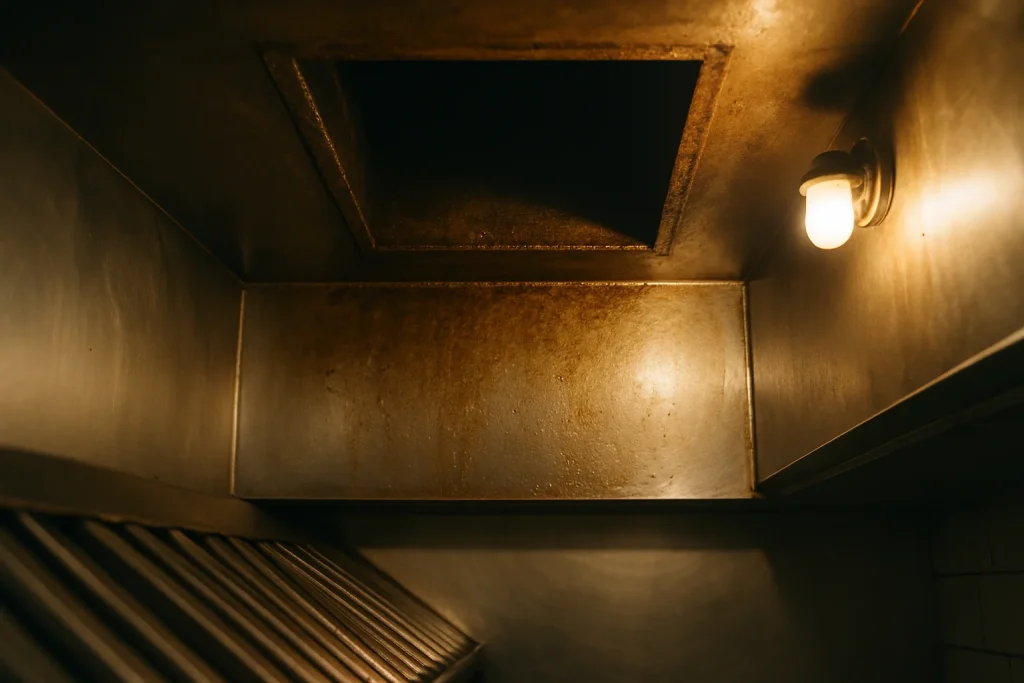
Commercial exhaust cleaning removes grease-laden deposits from the full exhaust system, duct, flue, and roof termination, serving Houston restaurants and food service operations that must maintain compliance with NFPA 96 and commercial property insurance requirements.
A grease-laden exhaust flue (the duct and flue system connected to fryers, grills, and ranges that carries aerosolized cooking grease out of the building) is categorically different from every other commercial exhaust system. The grease doesn’t pass through clean. It condenses on every interior surface as it moves from the Type I commercial hood, the exhaust hood installed directly over cooking equipment, upward through the duct run and out at the roof termination.
That deposit is combustible. It accumulates on a schedule tied directly to how much you cook and what you cook with. At 832 Home Service, we clean the full system, hood connection to roof termination, and we document the grease accumulation level found before cleaning and the flue condition confirmed after. That report goes to your insurer or fire marshal without any reformatting on your end.
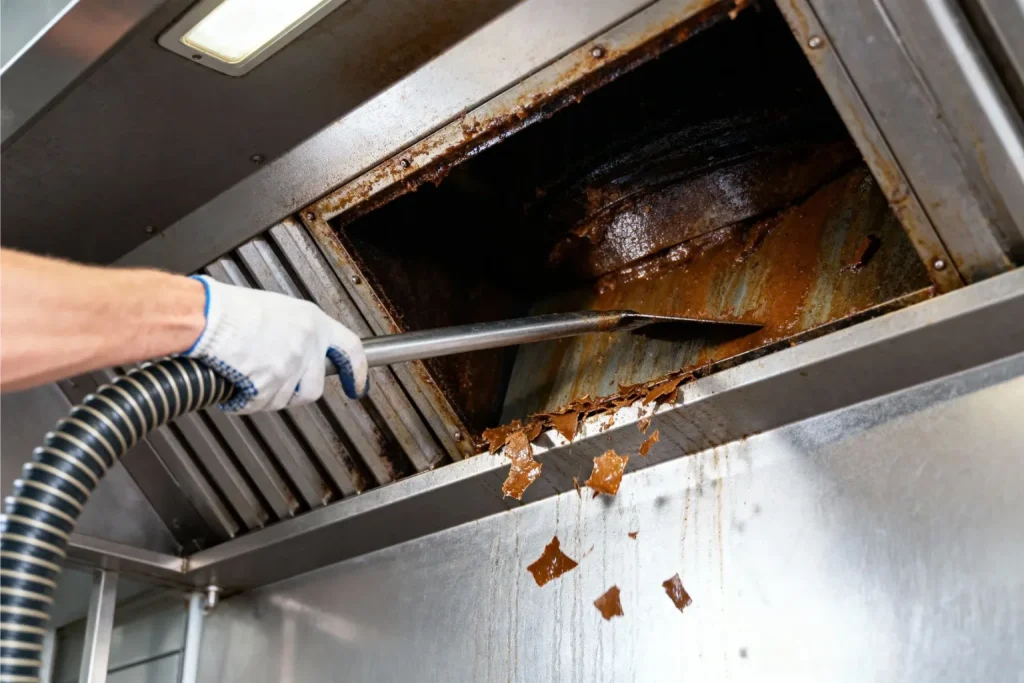
The service follows three phases, assessment, cleaning, and documentation, in that sequence, every time.
We begin by accessing the duct run at every available access panel. We assess the grease accumulation level, classified as light, moderate, or heavy, at each segment. We photograph and record findings before cleaning starts. If the system shows conditions outside normal accumulation for the declared cleaning interval, we note that in the pre-service record. This establishes the baseline your insurer or fire marshal will reference. We also confirm the roof termination condition before ascending: cap integrity, screen condition, and any grease pooling at the exit point.
Cleaning proceeds from the Type I commercial hood connection upward through the duct run to the roof termination. We use mechanical cleaning equipment at the duct segments and appropriate cleaning agents where grease deposits are bonded to duct walls. Containment is placed at every access point. No grease is released into the kitchen or ceiling space. Roof termination is cleaned last, cap removed, screen cleaned or replaced if damaged, duct exit cleared of accumulated grease. The termination is reassembled and condition confirmed before the technician descends.
After cleaning, we document the post-cleaning condition at each duct segment and photograph the roof termination. The complete service report, pre-cleaning grease accumulation level, cleaning method used, post-cleaning flue condition from hood to roof, is compiled and delivered to the operator the same day. The report is formatted for direct submission to commercial property insurers and fire marshal compliance auditors. No additional formatting required on your end.
“I walked into that Midtown kitchen expecting moderate accumulation. The duct run told a different story.”
Field account from the 832 Home Service crew
The operator had been on a semi-annual schedule. On paper, that interval works for lower-volume operations. But this kitchen runs four gas burners and two commercial fryers from lunch through late evening, seven days a week. NFPA 96 puts that squarely in the quarterly category. Six months between cleanings in a kitchen like that isn’t compliant, it’s a liability.
When I opened the duct access panel at the first cleaning joint above the Type I commercial hood, the grease accumulation level was already past moderate. The deposit had built to the point where the duct surface wasn’t visible in sections. I documented that finding, depth, coverage, location, before we touched anything. That pre-cleaning record matters. Your insurer wants to know what condition the system was in when we arrived, not just that someone cleaned it.
We cleaned the full run: hood connection, duct through the ceiling, flue section through the roof structure, and roof termination cap. Three technicians, proper containment, no grease released into the kitchen. Post-cleaning, I documented the flue condition at each access point and photographed the roof termination before and after.
The service report went to the operator that afternoon. It specified the cleaning method, the pre-cleaning grease accumulation level, and the post-cleaning condition of the system from hood to roof. The operator submitted it directly to their commercial property insurer without modification. That’s the deliverable we build toward on every job. Switching that kitchen to quarterly after this visit was the right call. It took one documented cleaning cycle to correct the interval. No gap in compliance, no repeat of that accumulation level.
NFPA 96 sets cleaning frequency based on what you cook, how much, and with what equipment, not a one-size schedule.
A lot of operators assume the fire code treats every commercial kitchen the same way. It doesn’t.
Most Houston restaurants running full dinner service fall into the quarterly category. Solid-fuel operations, wood-fired pizza, live-fire grill concepts, need monthly cleaning. Lower-volume operations like sandwich shops or light prep kitchens may qualify for semi-annual service.
We assess your operation type at the first visit. If your current cleaning interval doesn’t match your actual cooking volume and equipment profile, we document that finding and recommend the correct frequency. Getting the interval right is as important as the cleaning itself. An over-interval system creates a documentation gap. An under-interval schedule is an unnecessary cost. We size the recommendation to your actual operation.
High-volume solid-fuel cooking (wood, charcoal, mesquite)
High-volume gas or electric cooking (fryers, ranges, griddles)
Lower-volume or low-temperature operations (light frying, steam)
Every commercial exhaust cleaning we perform follows a fixed scope, no partial duct runs, no skipped terminations.
We clean from the Type I commercial hood connection through every duct segment to the roof, using all required access panels, not spot-cleaning visible sections.
Pre-service grease depth and coverage is recorded at each access point, this creates the before-and-after record your insurer requires.
After cleaning, flue condition is recorded at each segment and photographed at roof termination.
The exhaust cap, screen, and duct exit at the roof are cleaned and inspected on every job, this is the zone most frequently left out of limited-scope cleaning visits
The service report states the cleaning method used (mechanical, chemical, or combination), not just that cleaning occurred.
The service document is structured to satisfy commercial property insurance carrier documentation requests and fire marshal compliance audits, delivered ready to submit, no reformatting needed.
NFPA 96 sets frequency by your cooking type and volume. High-volume solid-fuel operations need monthly cleaning, high-volume gas or electric kitchens fall into the quarterly category, and lower-volume operations may qualify for semi-annual or annual service. We assess your operation at the first visit and recommend the interval that matches your actual cooking hours and equipment.
Yes. The exhaust cap, screen, and duct exit at the roof are cleaned and inspected on every job. The roof termination is the zone most frequently left out of limited-scope cleaning visits, so we clean it last and confirm its condition before the technician descends.
The service report is structured to satisfy commercial property insurance carrier documentation requests and fire marshal compliance audits. It includes the pre-cleaning grease accumulation level, the cleaning method used, and the post-cleaning flue condition from hood to roof. It is delivered ready to submit with no reformatting needed on your end.
Same day. After cleaning, we document the post-cleaning condition at each duct segment, photograph the roof termination, and compile the complete report for delivery to the operator the same day.
No. Containment is placed at every access point before cleaning proceeds from the Type I commercial hood connection upward through the duct run to the roof termination. No grease is released into the kitchen or ceiling space.
(832) 662-3437
Other work Houston homeowners commonly pair with this service.
Scheduled cleaning with compliance records.
Large-scale repair with full documentation.
High volume flue system kept safe and clear
Keep boiler flues efficient and safe.
832 Home Service provides commercial exhaust cleaning throughout Greater Houston and the surrounding region.
832 Home Service delivers full commercial exhaust cleaning from hood to roof termination, with a same-day compliance report ready for your insurer. We’ve served Houston food service…
Call 832 Home Service at (832) 662-3437 or email info@832chimneyservices.com to schedule your Commercial Exaust Cleaning assessment.
WhatsApp us
Tell us what’s going on and we’ll get back to you, often the same day.
Prefer to talk? (832) 662-3437