Smart Home Fireplace Installation in Houston, TX
Install a WiFi fireplace in Houston with protocol compatibility verified before unit selection. App, voice, and hub integration from day one.
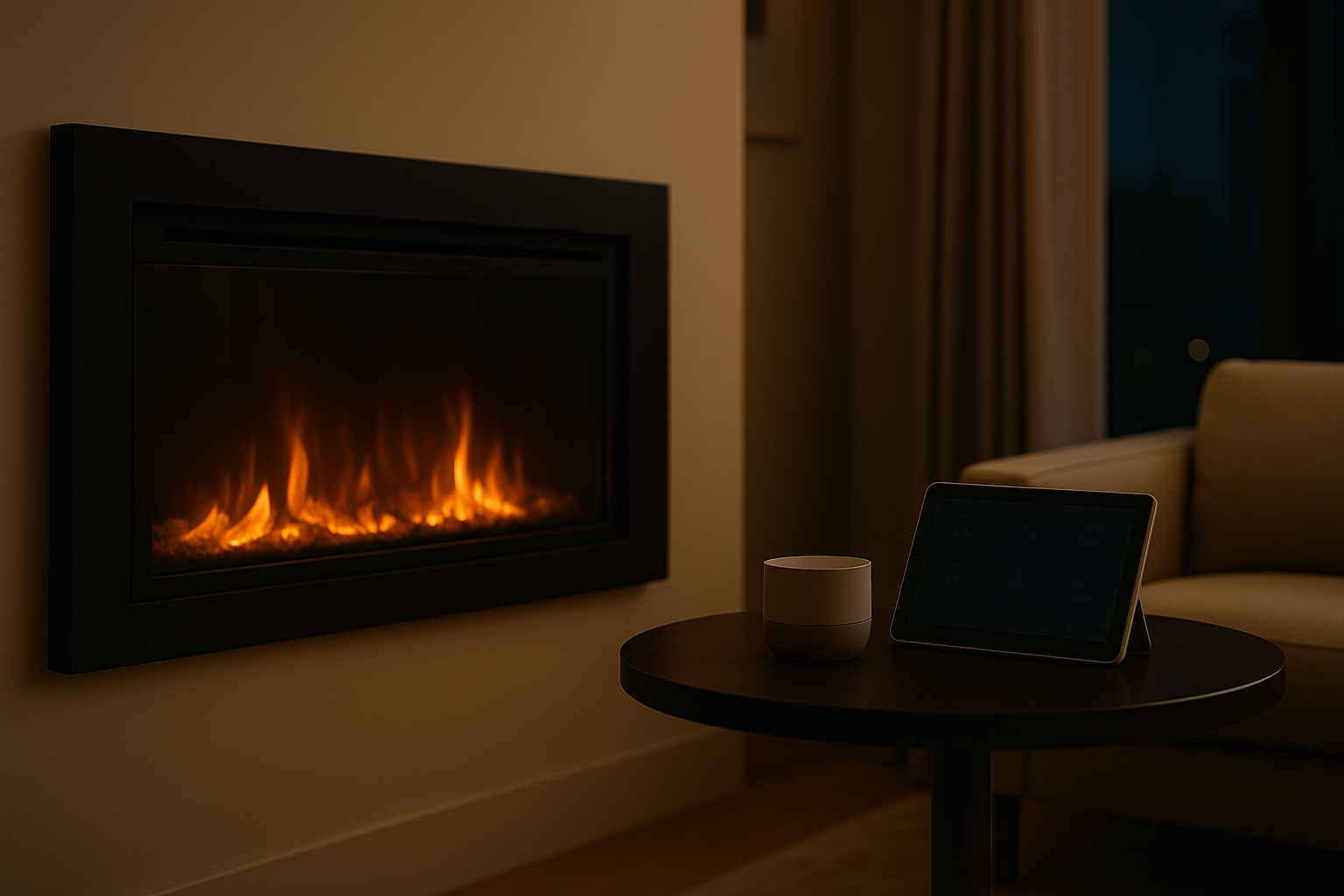
Smart Home Fireplace Installation in Houston, TX
Install a WiFi fireplace in Houston with protocol compatibility verified before unit selection. App, voice, and hub integration from day one. Call (832) 662-3437.
Protocol Verified First
Compatibility confirmed before unit selection, not after it arrives.
Full Hub Integration
App, voice, and scheduling working from day one, no workarounds.
Smart Fireplace Protocol Verified Against Your Home Automation Hub Before Unit Is Specified
Protocol compatibility is confirmed before any fireplace unit is selected, not after it arrives.
A smart fireplace installation starts with a question most installations skip entirely: what protocol does your hub use?
A smart fireplace control module, the electronic component inside the unit that receives wireless commands and translates them into fireplace operation signals, communicates over one of four standards. WiFi. Z-Wave. Zigbee. Bluetooth LE. Each is a home automation protocol: the communication standard a device uses to send and receive signals through your smart home system.
A module and a hub can both be "smart" and still not communicate with each other.
If the control module uses Z-Wave and your hub doesn't natively support it, you need a bridge device. That adds hardware, a potential failure point, and setup complexity. If the module uses Zigbee and your hub runs WiFi-only, you have the same problem.
At 832 Home Service, the protocol check happens before unit selection. We confirm what hub you're running, Samsung SmartThings, Amazon Echo, Apple HomeKit, or a dedicated automation controller, and which protocol it speaks natively. Then we specify the fireplace unit accordingly. The smart home hub, the central controller coordinating all your connected devices, integrates with the fireplace control module on day one. No bridge device. No workaround. No compatibility surprises after the unit is on the wall.
That single step is the difference between a smart fireplace installation and a standard gas fireplace with an unreliable add-on.
WiFi
Direct network-based control
Z-Wave
Mesh automation protocol
Zigbee
Low-power mesh standard
Bluetooth LE
Short-range direct pairing
A New Fireplace That Connects to Your Smart Home System From Day One
Getting smart control right at installation is far simpler than retrofitting it into a finished system later.
The Woodlands, Sugar Land, and Katy are Houston's highest smart home adoption communities. In these northern and western suburbs, new construction and whole-home renovations routinely include multi-hub automation setups, lights, locks, thermostats, shades, and security cameras all coordinated through a single controller.
A fireplace installed without smart control wiring and a compatible receiver cannot be upgraded later without partial disassembly of finished surfaces. The control wiring rough-in, the low-voltage wiring and receiver hardware that enables smart module installation, must go in before walls are closed.
Once drywall is finished and tile is set, adding smart control means cutting into surfaces already completed. That is a retrofit job: messier, more expensive, and sometimes impossible to execute cleanly depending on how the firebox was framed.
Specifying the smart control infrastructure at installation adds no extra labor. The rough-in happens during the same visit as the firebox framing. The module installs before the surround goes up. Everything is accessible, testable, and cleanly integrated before the project closes out.
Homeowners in The Woodlands and Sugar Land who include fireplace installation in a broader renovation scope get better outcomes, and lower total costs, when smart control is part of the original specification.
Projects Completed
Years Experience
Licensed & Insured
Google Rating
Smart Home Fireplace Installed and Integrated With Your Automation System in One Project
832 Home Service has installed smart home fireplace systems across Greater Houston since 2010.
Katy, Sugar Land, and The Woodlands represent a specific installation environment. Post-2005 construction in these communities tends toward tight building envelopes, multi-zone HVAC, and homeowners managing several dozen connected devices. A fireplace that runs on its own dedicated app, paired to the unit directly but not integrated with the home's automation hub, is half a smart fireplace.
App-based fireplace operation, the ability to start, stop, and adjust flame height from a smartphone, works as a standalone feature. But if your thermostat, lighting scenes, and security system all operate through one hub, a fireplace that responds only to its own manufacturer app sits outside that ecosystem. It doesn't participate in schedules. It doesn't respond to voice commands through your existing assistant. It doesn't trigger as part of a "movie night" or "arriving home" routine.
Our installations in The Woodlands and Sugar Land most often serve homes where the buyer thinks in terms of devices and hubs, not just gadgets. We work in that frame.
Crews
Since
Greater Houston
Twelve crews. Greater Houston service area. Smart fireplace installations running continuously since 2010 across communities where the automation stack is complex and integration expectations are high.
Voice and Scheduling: What Full Integration Actually Means
Voice assistant integration and fireplace scheduling require hub connection, not just phone pairing.
Buyers shopping smart fireplaces often focus on app control. That's reasonable. But voice assistant integration, the connection between your fireplace control module and Amazon Alexa, Google Assistant, or Apple Siri, requires the module to be integrated with your smart home hub, not just paired to a manufacturer app.
If the module is WiFi-paired to its own cloud service and that service doesn't support an Alexa skill or Google Home action, voice control doesn't function. The protocol path has to be complete end-to-end.
Fireplace scheduling, programming the fireplace to turn on before you arrive home or shut off after a set time, requires the same condition. Hub integration, not just app pairing. Your automation hub's scheduling function needs to see the fireplace as a controllable device, not just a paired accessory in a third-party app.
This is the distinction between a connected fireplace and a fully integrated one.
We specify units whose control modules carry confirmed compatibility with your hub's ecosystem, Alexa, Google, SmartThings, HomeKit, so voice commands work through the assistant you already use and scheduling works through the automation routines you've already built. No second app. No workaround integrations. The fireplace behaves like everything else in your home.
Our Standards for Smart Fireplace Installation
Every smart fireplace installation follows a fixed sequence: protocol check, unit selection, rough-in, module install, hub pairing, and integration test.
Protocol verification first. Hub type and native protocol confirmed before any unit is specified or ordered.
Unit selection against verified protocol. Fireplace chosen based on control module compatibility with your hub, not based on availability or manufacturer preference.
Control wiring rough-in during framing phase. Low-voltage wiring and receiver hardware installed before walls are closed.
Firebox installation to manufacturer specification. Clearances, venting, and gas supply completed before smart hardware is touched.
Smart control module installed and bench-tested. Module confirmed to receive commands before surround work begins.
Hub pairing completed on-site. Fireplace added to your automation controller and confirmed visible as a controllable device.
Voice assistant integration verified. Alexa, Google, or Siri command tested with the fireplace live.
Scheduling function tested. At least one automation routine triggered through your hub before the crew leaves.
We don't close the job until integration is confirmed working, not just installed.
Execution Protocol: How a Smart Home Fireplace Installation Works
The installation runs in three stages: diagnostic, implementation, and integration testing.
Hub and Protocol Diagnostics
The diagnostic phase happens before any material is ordered.
We review your existing smart home hub, make, model, firmware version, and native protocol. We confirm which communication standard it supports natively and whether any of the four major fireplace control module protocols require a bridge device. We note your voice assistant platform and confirm which hub-to-assistant integration path is active in your home.
From that assessment, we produce a compatibility brief: what the hub supports, which fireplace control modules are compatible without a bridge, and which units match your installation requirements, gas type, venting configuration, and firebox dimensions. You see the compatibility findings before any unit is ordered.
Firebox and Rough-In Implementation
Framing and gas rough-in happen first. Firebox dimensions are set. Clearances are measured and documented. Venting is configured.
Control wiring rough-in goes in during this phase, before walls are closed. Low-voltage wiring runs to the control module location. The receiver housing mounts in the firebox housing before the surround is installed.
Once the surround is set and the firebox is complete, the smart control module is installed, wired, and powered. The manufacturer's pairing sequence is completed with the module in final position.
Integration Testing
Hub pairing is completed with your home automation system powered and active. The fireplace appears in your hub's device list as a controllable appliance.
We test on/off commands from the app. We test voice commands through your assistant. We trigger one scheduling routine to confirm the fireplace responds correctly to hub-initiated commands, not just manual app commands.
If anything in the integration test doesn't perform correctly, we resolve it before the job is closed. The integration test is part of the scope, not a follow-up visit.
Areas We Serve
832 Home Service installs smart home fireplaces across Greater Houston and the surrounding region.
We serve The Woodlands, Sugar Land, Katy, Cypress, Tomball, Fulshear, Brookshire, Pearland, Friendswood, Missouri City, Stafford, League City, Clear Lake City, Webster, Seabrook, Humble, Spring, Conroe, Montgomery, and Willis, plus Houston's inner neighborhoods and the broader Gulf Coast service area including Galveston, Beaumont, and Bay City.
Related Services
Other work Houston homeowners commonly pair with this service.
Already have a fireplace? Add app and voice control to it.
Learn more →Standard install without smart controls.
Learn more →Gas logs are the usual base for smart control.
Learn more →Safety checked before any controls go in.
Learn more →Ready to Add a Smart Fireplace to Your Houston Home?
832 Home Service handles smart home fireplace installation from protocol check to integration test, one project, one crew, one visit to completion.
Start with a conversation about your hub. Tell us what you're running, where you want the fireplace, and what voice assistant you use. We'll confirm protocol compatibility before anything is specified.
Tell us about your smart home setup, hub type, current devices, and where you want the fireplace.
© 2026 832 Home Service. Smart fireplace installation in Houston, protocol verified before unit selection. Call (832) 662-3437.