Forensic Chimney Diagnostics in Houston, TX
One definitive answer, not three conflicting ones. A systematic, evidence-based investigation into chimney problems standard service visits have not resolved.
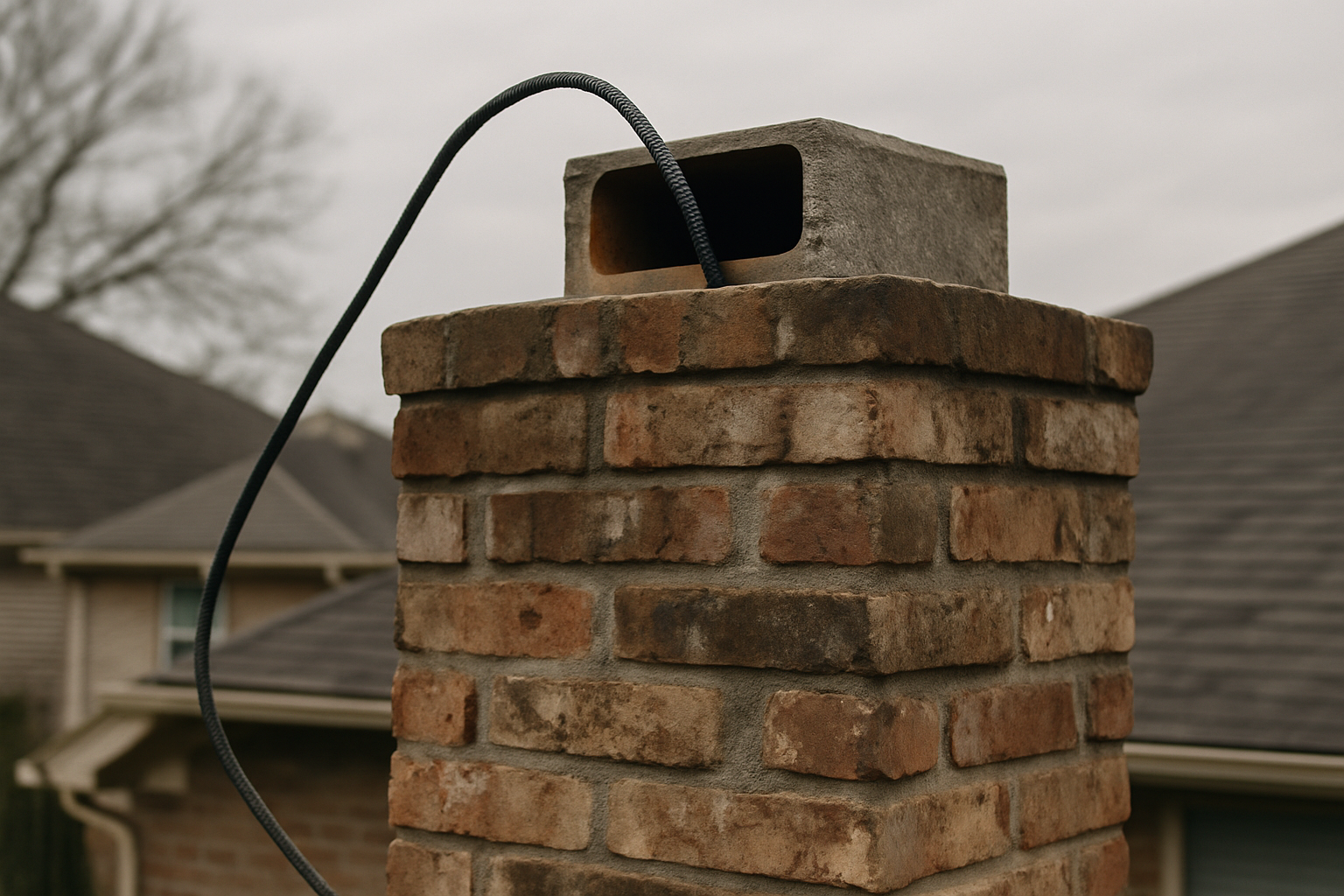
Forensic Chimney Diagnostics in Houston, TX
Forensic Chimney Diagnostics Gives You One Definitive Answer, Not Three Conflicting Ones
Forensic chimney diagnostics is a systematic, multi-method investigation into chimney problems that standard inspection, cleaning, or previous repairs have not resolved.
It applies when a chimney is producing multiple simultaneous symptoms, smoke spillage, water stains, persistent odor, or some combination, and no single prior service visit has connected those symptoms to a confirmed root cause. The investigation process tests each possible cause in sequence, rules it out or confirms it with evidence, and produces a written diagnostic log documenting exactly how the conclusion was reached.
Houston Chimneys Present Exactly the Conditions That Make Multi-Symptom Diagnosis Necessary
Houston's older masonry chimneys are built for a climate that doesn't cooperate with simple single-cause failures.
The Gulf Coast's humidity doesn't just affect one component. It works on mortar joints, crown concrete, flashing seals, and liner surfaces at the same time. A Houston chimney standing since the 1970s in Tanglewood, Afton Oaks, or Upper Kirby has been exposed to four decades of thermal cycling, cool winters, brutal summers, and tropical storm events that deliver wind-driven rain at roofline angles dry-climate construction never anticipated.
Here's what most homeowners don't realize about older Houston masonry chimneys: when moisture has been entering a system for years, visible symptoms tend to appear downstream from the actual entry point. A ceiling stain doesn't always mean the leak is above the stain. A persistent odor after rain doesn't always mean the source is the flue.
A chimney presenting three symptoms on a Houston property from this era almost never has three separate, unrelated causes, but it also rarely has just one. The diagnostic work is in figuring out which symptoms are connected and which are independent.
This is the specific diagnostic scenario that forensic chimney diagnostics in Houston is designed to address.
The Elimination Methodology: How Forensic Chimney Diagnostics Actually Works
Forensic chimney diagnostics works by testing causes in sequence, not by inspecting components in order of accessibility.
The distinction matters. A standard inspection typically moves from the most accessible component, cap, crown, exterior masonry, toward less visible components like the liner, smoke chamber, and damper. That approach works well when the problem is visible from the outside and involves a single component.
It works less reliably when three symptoms are present simultaneously and the relationship between them is unknown. Starting with the most accessible component can result in repairing a legitimate problem that isn't actually causing the reported symptoms, a real repair that doesn't resolve the real problem.
The elimination methodology starts differently.
Symptom Mapping: Building the Matrix Before Any Physical Testing
The first step is symptom mapping, the process of correlating each reported chimney symptom to every system component capable of producing it.
Think of it as a matrix. Smoke spillage into the living room maps to: damper function, flue blockage, negative pressure at the firebox opening, liner integrity, and stack effect disruption. Water stains on the ceiling near the chimney breast map to: flashing failure, crown cracking, mortar joint deterioration, and liner condensation. Persistent odor after rain maps to: creosote reactivation from humidity, liner gaps that allow odor migration, and unaddressed animal residue.
When all three symptoms are mapped, the components appearing in multiple columns become visible. Those components, the ones that are a plausible cause for two or more symptoms simultaneously, are where the elimination sequence begins.
Symptom mapping directs the investigation toward the most diagnostic areas first, not the most accessible ones.
The Elimination Sequence: Confirmed or Ruled Out at Every Step
Once the symptom map is built, the physical investigation follows the sequence it points to.
Each potential cause is assessed with enough specificity to confirm it or rule it out. Not "the flashing looks worn", but a moisture intrusion test under controlled conditions that confirms or rules out flashing as the active water entry point. Not "the liner seems okay", but a camera inspection of the full flue height, documenting every gap, crack, or joint failure that could contribute to odor migration or smoke spillage under negative pressure.
Every result directs the next step. If the flashing test rules out flashing as the water source, the investigation moves to the crown. If a crown crack is found and confirmed as active, the investigation then asks whether that crack is connected to the odor symptom through moisture reactivating creosote deposits in the upper flue.
Root Cause vs. Contributing Factor: The Distinction That Changes the Repair Plan
Forensic diagnostics distinguishes between root causes and contributing factors, the difference between the primary failure producing a symptom and the secondary conditions that worsen or extend it.
For example: a cracked liner (root cause) allows humidity into the surrounding masonry (contributing factor), which produces efflorescence on the exterior brick (visible symptom). Treating only the efflorescence means it returns. Treating only the liner crack without addressing the saturation already in the masonry means moisture damage continues. The repair plan has to address both, in the correct sequence.
That's the level of analysis the elimination methodology produces.
The Diagnostic Log: A Written Record, Not a Verbal Summary
At the end of the investigation, the homeowner receives a diagnostic log, a written record documenting every test performed, the result of that test, and how that result directed the next step.
"The problem is your flashing and you've got some liner issues."
Step 1, moisture intrusion test performed at flashing perimeter under water pressure. Result: active infiltration confirmed at north-facing corner. Step 2, cap and crown assessed for secondary entry. Crown crack present but sealed, ruled out as active source. Step 3, liner camera inspection performed...
The homeowner can see the reasoning. They can share it with a second opinion. They can use it to get an accurate repair quote because the scope is defined by evidence, not assumption. That's what forensic chimney diagnostics produces that a standard inspection, even a thorough one, typically does not.
Three Situations Where Forensic Chimney Diagnostics Changed the Outcome in Houston
Most multi-symptom chimney problems have a diagnostic thread, once you find it, the repair path becomes clear.
Older masonry chimney, three prior service calls
A homeowner had received three separate assessments over two years. One focused on the flashing. One recommended liner replacement. One cleaned the flue and suggested monitoring. The symptoms, smoke, stain, odor, continued. When 832 Home Service performed a forensic chimney diagnostic on the property, symptom mapping identified that both the smoke and odor symptoms shared the damper and upper smoke chamber as a common component. The liner recommendation was based on a real condition, minor joint separation, but that condition was not producing any of the reported symptoms. The flashing had been repaired but was no longer the active water source. The primary cause was a smoke chamber mortar failure that was directing smoke and concentrating odor-producing deposits in a location no prior visit had addressed. The repair scope was specific, bounded, and didn't require liner replacement.
Post-storm odor and ceiling stain combination
After a tropical weather event, a homeowner reported a new ceiling stain and a worsening fireplace odor. Initial assumption was flashing damage. The forensic diagnostic confirmed minor flashing movement, but the moisture intrusion test showed the active entry point was crown cracking opened by storm pressure, not flashing. The odor source was separate: a previously undetected animal nest residue in the upper flue, reactivated by the moisture increase. Two causes. One shared triggering event. The repair plan addressed both independently, in the correct sequence.
New homeowner, no prior service records
A homeowner purchasing a property with a fireplace had no prior service records. A forensic diagnostic established a complete baseline: liner condition, smoke chamber integrity, cap and crown status, flashing seal, damper function, and creosote level. This wasn't resolving a mystery, it was creating a documented starting point. The written diagnostic log gave the new owner a full chimney system component map and a prioritized list of what needed attention immediately versus what was serviceable for another season.
What Fourteen Years of Houston Chimney Diagnostics Has Taught Me
The most common pattern in multi-symptom chimney work is addressing symptoms in the order they're reported.
I've been doing this work in Houston since 2010. The cases that come to us after multiple prior visits almost always share one characteristic: each previous visit addressed the symptom that appeared first or the component the technician was most familiar with. That works fine when there's only one symptom.
When there are three symptoms with overlapping possible causes, you need a different approach. You have to build the matrix before you touch anything. Once I know which components appear in two or more symptom columns, I know where to start. Every result from that point narrows the next step.
The other thing I've learned about Houston specifically: this climate doesn't produce clean, isolated failures very often. A chimney that's been standing through Houston summers and tropical storm seasons for thirty years has usually experienced compound weathering, multiple components degrading at overlapping rates. That's not a reason to replace everything. It's a reason to be systematic about which failures are active and which are stable, and to address them in the right order.
The diagnostic log is how we show our work. It gives the homeowner a traceable record of what was tested, what was found, and why the repair scope is what it is.
When Forensic Chimney Diagnostics Is the Right Next Step
Forensic chimney diagnostics is the right call when a structured investigation is needed before any repair decision is made.
Consider scheduling a forensic chimney diagnostic in Houston when:
- ✓You've had the chimney inspected or serviced and the same symptoms continue.
- ✓Multiple assessments have pointed to different causes.
- ✓Two or more symptoms, smoke, water, odor, or structural, are occurring at the same time.
- ✓You're inheriting a chimney with no prior service records and want a complete documented baseline.
- ✓A repair was completed and the problem returned within one or two seasons.
You don't need to know what's wrong before calling. That's what the diagnostic is for.
Bring a clear description of every symptom to the call, when it appears, under what conditions (rain, fire, both, neither), and how long it's been present. That information is the starting point for the symptom map, and it directs everything that follows.
Areas We Serve
832 Home Service performs forensic chimney diagnostics across the Greater Houston area.
We serve Houston neighborhoods including Tanglewood, Afton Oaks, Upper Kirby, Midtown, Montrose, the Heights, and Bellaire. Our service area extends to Pasadena, Pearland, Sugar Land, Katy, The Woodlands, League City, Friendswood, and Baytown. We also serve Galveston, Texas City, Beaumont, Conroe, Humble, Cypress, and surrounding communities throughout the region.
Frequently Asked Questions
What makes forensic chimney diagnostics different from a standard inspection?
A standard inspection moves from the most accessible component toward less visible ones, which works when a single problem is visible from outside. Forensic diagnostics instead tests causes in sequence based on a symptom map, ruling each one out or confirming it with evidence, and produces a written diagnostic log documenting exactly how the conclusion was reached.
When should I schedule a forensic chimney diagnostic?
Schedule one when the same symptoms continue after inspection or service, when multiple assessments have pointed to different causes, when two or more symptoms (smoke, water, odor, or structural) occur at the same time, when you're inheriting a chimney with no service records, or when a completed repair returned within one or two seasons.
Do I need to know what's wrong before I call?
No. That's what the diagnostic is for. Bring a clear description of every symptom, when it appears, under what conditions (rain, fire, both, neither), and how long it's been present. That information is the starting point for the symptom map and directs everything that follows.
What is the diagnostic log and why does it matter?
The diagnostic log is a written record documenting every test performed, its result, and how that result directed the next step. It lets you see the reasoning, share it for a second opinion, and get an accurate repair quote because the scope is defined by evidence, not assumption.
Why does Houston's climate make multi-symptom diagnosis more common?
The Gulf Coast's humidity works on mortar joints, crown concrete, flashing seals, and liner surfaces at the same time. A chimney standing through decades of Houston summers and tropical storm seasons usually experiences compound weathering, with multiple components degrading at overlapping rates, so isolated single-cause failures are uncommon.
Related Services
Other work Houston homeowners commonly pair with this service.
Measure draft behaviour under real conditions.
Learn more →Standard draft testing for smoke problems.
Learn more →Instrumented testing across the whole system.
Learn more →Invasive inspection when damage is hidden.
Learn more →Ready to Get Started?
Contact our team today for a free consultation. A forensic chimney diagnostic gives you a documented foundation for every repair decision that follows.
If you're dealing with multiple chimney symptoms, conflicting prior diagnoses, or a chimney with no documented service history, contact 832 Home Service to discuss whether a forensic diagnostic is the right starting point. Tell us what you're seeing and when it occurs. We'll explain what the elimination process covers and what the diagnostic log will document before any repair work begins.
© 2026 832 Home Service. Forensic Chimney Diagnostics in Houston, TX. All rights reserved.