We measure what your chimney actually does when running, not just how it looks when cold. Sequential testing misses interaction effects. We run all three instruments simultaneously while the appliance is burning, delivering measured findings, not guesswork.
Chimney technical diagnostics Houston means measuring draft performance under load, not confirming structure at rest.
A visual inspection tells you what the components look like when the chimney is cold and the appliance is off. That matters. But it answers a different question than the one a homeowner with a draft problem is actually asking.
A damper that opens fully. A liner with no visible cracks. A crown with no missing sections. All of those findings can be accurate and the chimney can still underperform when the appliance runs.
The measurement that resolves this is taken while the fire is burning. Draft gauge pressure readings, smoke pencil airflow observation, and flue gas CO monitoring, all three, simultaneously, at the moment the system is under load. That’s what a chimney airflow diagnostic in Houston captures that a cold visual inspection cannot.
A correction plan based on measured values is a different document than one based on visual findings.
When a repair is done correctly and the draft issue continues, the structural problem and the performance problem were likely not the same problem. An instrument-based correction plan specifies which variable in the system produced the measured draft deficiency. It names the physical change that addresses that variable. And it references specific numbers: the pressure differential recorded, the flow direction at the damper throat, the CO concentration at the test point.
That’s a precise document. It identifies what the measurements confirmed.
One diagnostic visit. Three instruments. Written findings before the crew leaves.
Every chimney airflow diagnostic at 832 Home Service follows a defined instrument protocol.
Vapor-permeable penetrating repellent only. No film-forming sealers oDigital pressure measurement at the firebox opening and at the flue outlet during live appliance operation. Readings recorded at ignition, steady state, and peak output.n exterior chimney masonry.
Flow direction and velocity observation at the firebox face, damper throat, and room perimeter. Smoke stream behavior recorded at each point simultaneously with gauge readings.
Continuous CO concentration reading in the flue gas stream from ignition through steady-state burn. Threshold alerts documented.
Cross-sectional area and height-to-opening ratio confirmed against the connected appliance's output spec before testing begins. Sizing mismatches that affect draft velocity are flagged before instruments run.
All major exhaust systems, HVAC, range hood, bath fans, activated during the test period to reproduce operating-condition interaction effects. This is how we capture what sequential testing misses
Delivered before the crew leaves. Specifies which measured variable produced the draft deficiency and what physical correction addresses it.
Visual inspection cleared the system. Draft gauge readings under load told a different story.
A homeowner in Webster had a gas insert that occasionally reversed, not every fire, not every season. Intermittent enough that two prior visual inspections hadn’t captured a cause. Liner intact. Damper functional. No obstruction. We set up for a live-operation test. A draft gauge, a manometer that measures the pressure differential between the flue and the room at the fireplace opening, clipped to the firebox surround.
Smoke pencil positioned at the damper throat. CO monitor in the flue stream. Then we activated everything: the insert, the HVAC system, the range hood in the kitchen. About four minutes into the burn, the smoke pencil reversed. It stopped flowing toward the flue and began tracking toward the room.
The draft gauge dropped below the threshold for stable draw. The CO reading in the flue stream climbed. The HVAC return was pulling from the same zone as the fireplace, while the range hood added a second draw. Together, they depressurized the room enough to reverse the flow.
That’s a flue gas CO monitoring finding, measuring carbon monoxide concentration in the flue gas stream during live operation, combined with a pressure and flow observation taken at the same moment. The correction plan was specific: a combustion air inlet, not a liner replacement. A visual inspection would never have produced that answer.
832 Home Service serves Clear Lake City, Webster, and Friendswood, post-1985 prefab fireplace territory where pressure interaction testing is most diagnostic.
Post-1985 construction in Clear Lake City, Webster, and Friendswood introduced something that older Houston homes don’t have in the same concentration: multi-appliance HVAC systems, tight building envelopes, and prefabricated fireplace inserts, all sharing the same air supply.
A prefab fireplace in a sealed, air-conditioned house doesn’t just compete with the HVAC for air. It competes with the range hood, bathroom exhausts, and any other device drawing air out of the structure simultaneously. The flue geometry that was adequate when the house was built can become marginal the moment a second exhaust appliance activates.
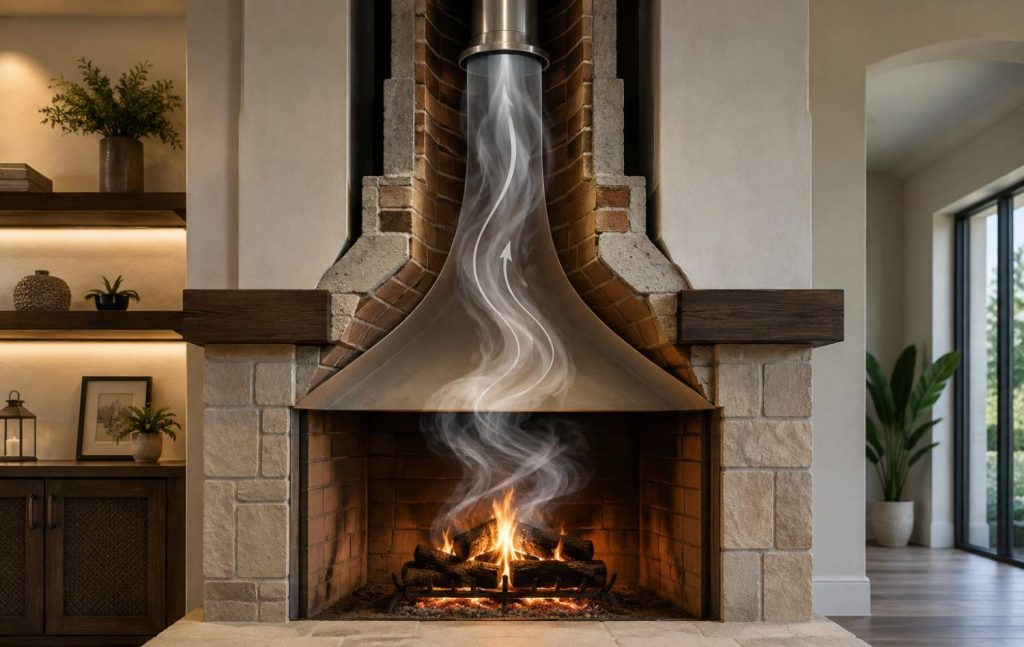
That’s an interaction effect, the term for what happens when two or more operating systems combine to produce a draft condition neither would create alone. Chimney pressure testing in Houston that tests systems one at a time cannot reproduce that condition. Live-operation testing with all relevant appliances running simultaneously can.
Sequential testing misses interaction effects. We run all three instruments simultaneously while the appliance is burning.
Before instruments are activated, we document the flue's cross-sectional dimensions, total height, and the connected appliance's BTU output and exhaust volume specifications. A flue undersized for its appliance produces chronic marginal draft without producing obvious structural failure. Identifying that before testing begins prevents misattributing cause to a pressure problem when the real issue is dimensional. If a sizing mismatch is found, it's noted in the pre-test documentation. Testing still proceeds, interaction effects can compound a sizing problem or exist independently of it.
Appliance ignited. Draft gauge active at the firebox opening. Smoke pencil positioned at the damper throat. CO monitor reading the flue gas stream. All household exhaust appliances running. We hold the test through four stages: cold start, warm-up, steady-state burn, and peak thermal output. CO concentration is monitored continuously. This is live-operation testing, capturing the system's actual performance under full household load. Interaction effects, if present, appear in the data during steady-state or peak output when competing systems are drawing the most air.
Once testing is complete, we compile the readings into a written correction plan. The document identifies the variable, pressure differential, flow reversal, CO elevation, flue geometry mismatch, or interaction effect, that measurements confirm as the draft deficiency source. The correction plan names the specific physical change that addresses that variable. If more than one variable is contributing, each is listed in order of impact. The homeowner receives this document before the technician leaves the property.
If a visual inspection confirmed no structural problem but your draft issue continues, instrument testing under live operation is the next step. It measures performance under load rather than confirming structure at rest.
Sequential testing misses interaction effects. Running the draft gauge, smoke pencil, and CO monitor simultaneously while the appliance burns reproduces the exact condition that produces the draft deficiency, something one-at-a-time testing cannot capture.
A written correction plan delivered before the crew leaves. It identifies the measured variable that produced the draft deficiency and names the specific physical change that addresses it, referencing recorded pressure, flow, and CO values.
Describe your symptom and when it occurs: smoke spillage, backdraft, slow draw, or intermittent reversal. We’ll confirm what live-operation testing can capture and book your visit accordingly.
(832) 662-3437
Other work Houston homeowners commonly pair with this service.
Fix the draft once the cause is known.
Standard draft testing for smoke problems.
Full workup for stubborn, unexplained faults.
A damaged smoke chamber wrecks draft.
832 Home Service applies chimney waterproofing treatments throughout Greater Houston and the surrounding region.
If a visual inspection confirmed no structural problem but your draft issue continues, instrument testing under live operation is the next step. Contact our team today for a free consultation.
Call 832 Home Service at (832) 662-3437 or email info@832chimneyservices.com to schedule your chimney airflow diagnostic in Houston. We’ll confirm what live-operation testing can capture and book your visit from our Houston dispatch at 2 Mockingbird Cir, Houston, TX 77074.
WhatsApp us
Tell us what’s going on and we’ll get back to you, often the same day.
Prefer to talk? (832) 662-3437