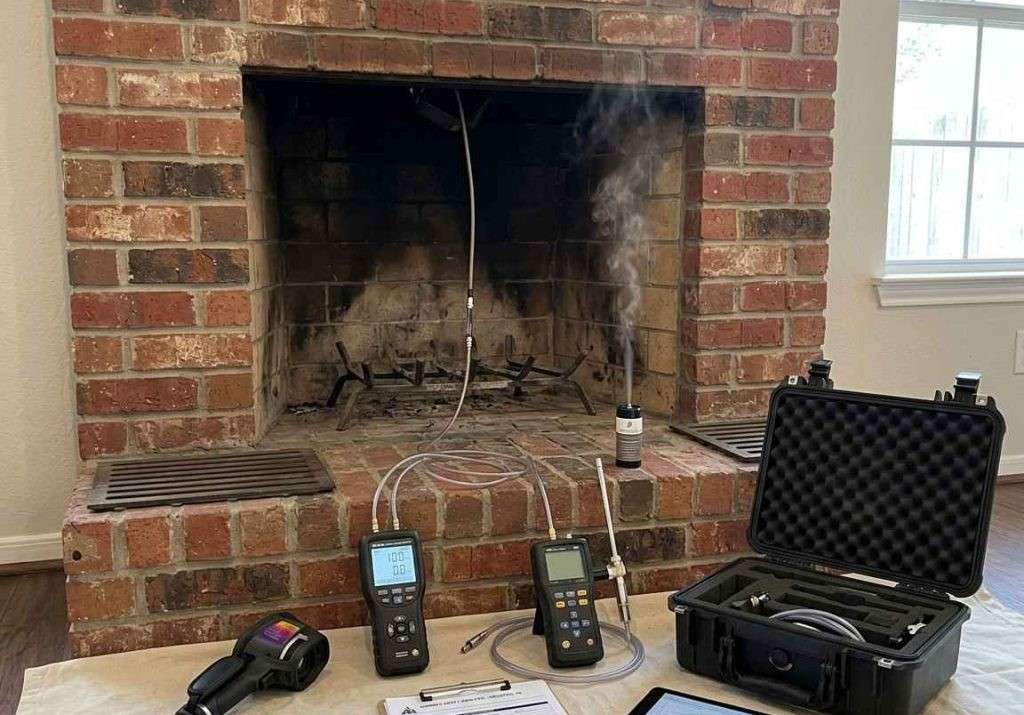
We test with HVAC running, range hood active, and exhaust fans on, because the failure only appears when the right systems combine.
Your chimney is structurally sound. It was inspected. It was cleaned. And it still pushes smoke into the room.
When that happens, the chimney usually isn’t the problem the building is. Indoor air pressure can fall below outdoor pressure, and that pressure difference pulls air down the flue, directly opposing the draft your fireplace needs. A standard inspection measures the chimney. It doesn’t measure the house working against it.
Forensic draft analysis measures the conditions a standard inspection never captures, isolates the exact combination of systems that triggers the failure, and delivers the finding in writing.
A single visit captures one pressure state. If the failure doesn’t exist in that state, the visit finds nothing and you’re told the chimney is fine.
That’s why these failures get called “intermittent.” They aren’t random. They appear when the right systems run at the same time: the HVAC handler cycling, a range hood pulling hard, a bathroom fan running, and interior doors closed in a particular pattern. Change any one of those and the symptom disappears which is exactly why it survives inspection.
Newer, tighter Houston construction makes this more common, not less. A well-sealed envelope has less unintentional make-up air available, so exhaust equipment pulls harder against the flue. Homes built after 2000 with central HVAC are the ones we see most often.
Not every smoking fireplace needs this. It’s the right call when the ordinary answers have already been tried.If your chimney hasn’t been inspected yet, start there a Tier 1 inspection is the right first step, and it’s cheaper. Forensic analysis is for what’s left when that comes back clean.
The chimney has been inspected and cleaned, and the draft failure continues.
You've received conflicting diagnoses from different contractors.
The failure is inconsistent some days fine, some days not.
You live in a post-2000 home with a central HVAC system.
We don’t test the chimney in isolation. We test the house as a system, under the conditions you actually live in. Each combination is measured, not estimated. The goal is a repeatable trigger the specific set of conditions under which the draft fails every time.
Draft measured in both states. Handler operation alone can flip a working flue into reversal.
A high-capacity hood is often the single largest exhaust load in the house.
Bath and utility fans are small individually and significant in combination.
Door position changes how air moves between zones and can isolate the fireplace from make-up air.
Every chimney waterproofing job at 832 Home Service follows the same documented standards product category, application rate, and sequencing rule. We apply the same standards to a single-flue brick chimney in Friendswood as we do to a multi-flue stack in The Woodlands. The documentation follows the same format either way. Our process is not flexible on the following points:
Vapor-permeable penetrating repellent only. No film-forming sealers on exterior chimney masonry.
Waterproofing is applied only after structural repairs - crown, mortar joints, flashing, spalling brick - are complete and cured. This includes mortar repointing before waterproofing is applied to ensure every joint is fully closed and cured before the water repellent goes on, as well as completing any spalling brick repair Houston homeowners need first before sealer is applied. No exceptions.
Product type, application rate, date, and technician on every job. Filed and accessible.
Surface moisture is confirmed acceptable before product goes on. Chimneys with elevated readings are rescheduled.
The full above-roofline section - the primary weather exposure zone - receives treatment. Not just visible front faces.
The volume of water repellent applied per square foot is recorded for every chimney. This determines how deeply the product penetrates and how long treatment remains effective.
You get a document you can act on and hand to any contractor for a second opinion.
Which building systems, running together, create the failure.
The measured differential under each triggering condition, not a guess.
Whether it is a combustion air deficit, HVAC interference, or both.
The class of fix the cause calls for, so the next step is clear.
When the chimney is structurally sound but still smokes into the room, the cause is often building pressure, not the chimney. Forensic draft analysis identifies the conditions standard inspection does not measure.
It is the condition in which indoor air pressure falls below outdoor air pressure, caused by exhaust fans, HVAC imbalances, or tight construction. It pulls flue air downward, opposing normal chimney draft.
A single inspection captures one pressure state, and the failure may not exist in that state. We measure draft under HVAC running and off, range hood active and off, exhaust fans on and off, and interior doors in different combinations.
Call when the chimney has been inspected and cleaned yet the draft failure continues, when the failure is inconsistent, when you have received conflicting diagnoses, or when you live in a post-2000 home with a central HVAC system.
It identifies which building system combination creates the failure, the pressure differential under each triggering condition, whether the cause is combustion air deficit, HVAC interference, or both, and the correction category most appropriate for the cause.
(832) 662-3437
Other work Houston homeowners commonly pair with this service.
Full workup for stubborn, unexplained faults.
Standard draft testing for smoke problems
Fix the draft once the cause is known.
A damaged smoke chamber wrecks draft.
Contact our team today for a free consultation.
Call 832 Home Service at (832) 662-3437 or email info@832chimneyservices.com to schedule your Chimney Repointing assessment.
WhatsApp us
Tell us what’s going on and we’ll get back to you, often the same day.
Prefer to talk? (832) 662-3437